Hanael, Archangel of Venus
Dec 19, 2022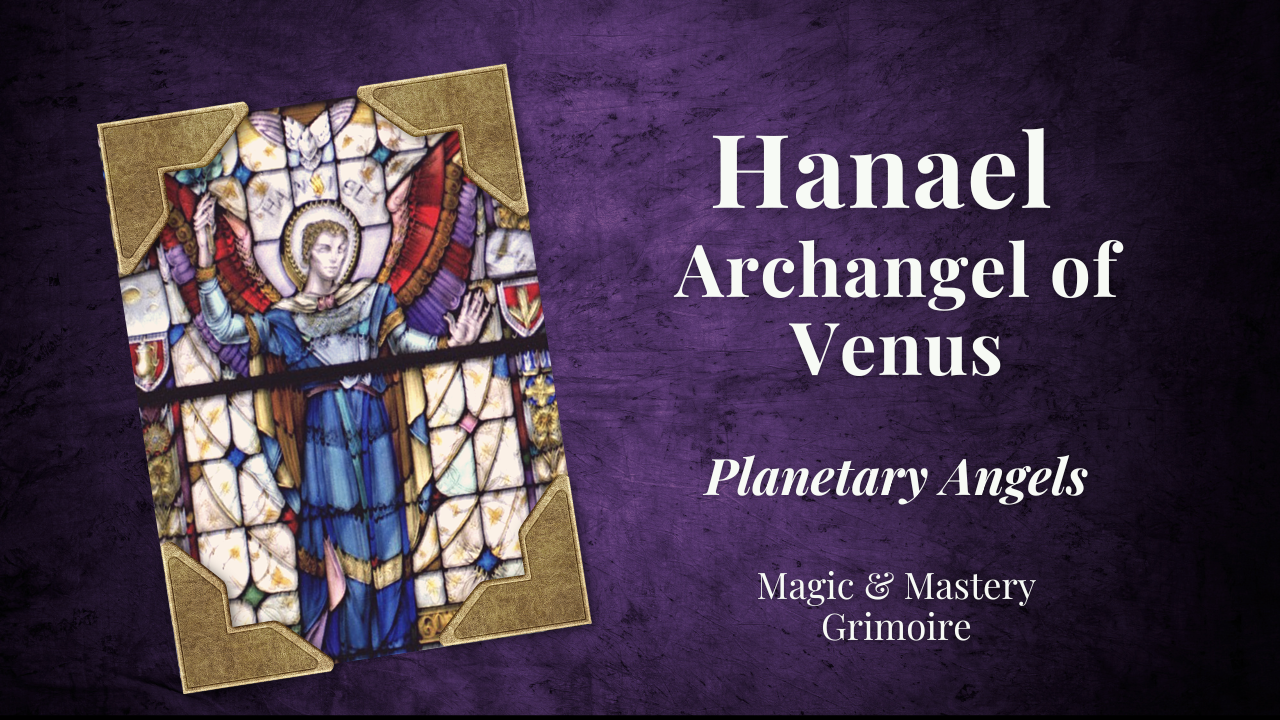
Most people think of Venus as the planet of love and leave it there. Hanael suggests the tradition had something considerably deeper in mind.
Hanael, the angel of joy, pleasure, beauty and nature, is the perfect fit for the Archangel of Venus. Meaning "Joy of God" or "Grace of God," the name Hanael likely stems from the Hebrew words hana'ah plus the suffix –el. Other spellings of the name have included Haniel, Anael and Aniel.
In art and iconography, Hanael is traditionally depicted in dark emerald green, smiling or laughing. She appears more often in female form than in male. In various images, she carries a rose, a lantern, or a wand tipped with a pinecone, called a thyrsus. All of these symbols are deeply intertwined with the planet Venus.
After the Sun and Moon, Venus is by far the brightest object in the sky. So bright that she casts her own shadow, and can even be seen in the daytime, if you know exactly where to look. But, as a planet between Earth and the Sun, to observers on our planet, she never travels far from the Sun before she's drawn back to its embrace. She is forever dancing between her guise as morning star and evening star.
To the Hellenistic Greeks, who invented our familiar form of astrology, Venus was the ideal icon of love and beauty; she captivates us. In their baser form, these become physical pleasures or the desire to create beautiful works. But in its highest expression, they draw us to union with the Divine, just as Venus is always drawn back to reunite with the Sun.
And so as the Archangel of Venus, Hanael helps us find joy and pleasure in all circumstances, to create beauty in art or music, or harmony in relationships. And it's Hanael who reminds that while earthly love is a gift, it's in divine love that we find our ultimate fulfillment.
Hanael's rose is also an ancient symbol of Venus. In relation to Earth, Venus' orbit traces out a five-pointed star every eight years. This beautiful astronomical effect has been called the Rose of Venus, a reference to the five-petalled flower, a favorite of the love goddess.
Hanael's emerald green tunic evokes the alchemical color of Venus — green — and the fecundity of Nature. It's Hanael's gift to make fruitful what was once barren.
The thyrsus carries a similar meaning. Carried by the followers of Dionysus, the pine-cone-topped wand conjures images of fertility, pleasure, hedonism and renewal. But on a deeper level, it alludes to another mystery — the union of male and female energies activates the pineal gland, the so-called "third eye" that brings true spiritual vision.
And we can't forget Hanael's lantern. One of Venus' earliest epithets was "light bringer"; she lights our way back to the divine. In fact, in the Zohar, one of the foundational texts of the Qabala tradition, it was Hanael who was chosen to carry Enoch to heaven in the Merkabah to encounter God.
On the Qabalistic Tree of Life, Venus and Hanael are represented by the sephiroth Netzach — Victory. Netzach is the sphere of pre-verbal feeling: not emotion as a concept you've organized into language, but the raw thing that precedes language entirely. The gut response. The magnetic pull. Desire before it has a name. The life force moving through the body the way it moves through the green world — not according to a plan, but according to its own deep logic. The spiritual experience of Netzach is the vision of beauty triumphant: the sudden overwhelming sense that beauty is real and that you are inside it. That is Hanael's domain and her gift.
When you crave the soothing balm of love and beauty in your life, or need to reconnect with the sweetness of the divine, seek Hanael's aid and counsel. The most auspicious time to call upon her is Friday, Venus' day, or in the hour of Venus.
Looking for another Archangel? Return to Introducing the Planetary Archangels.