What the August 2026 Pisces Lunar Eclipse Brings
Jan 23, 2026
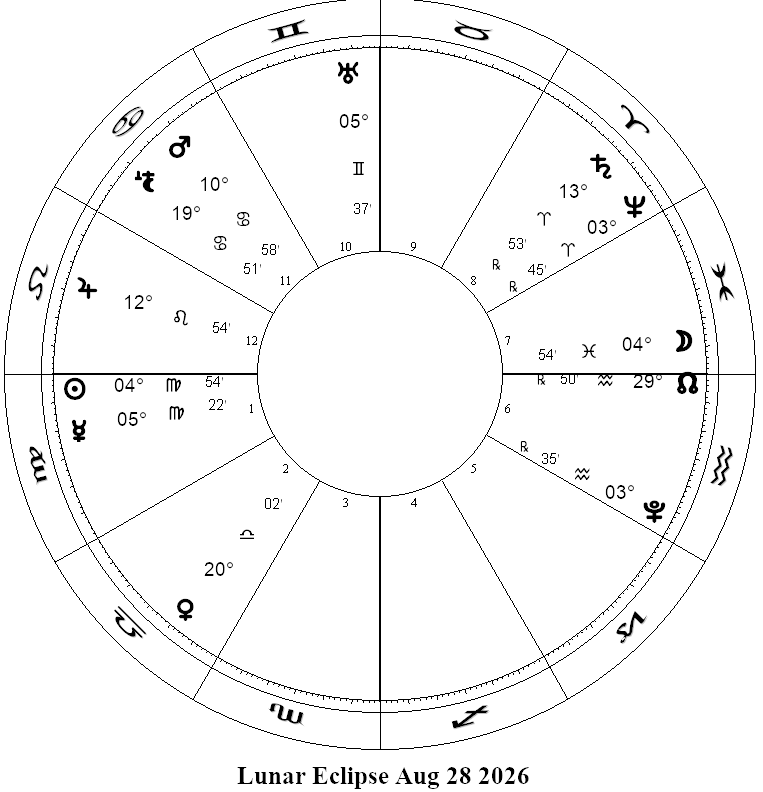
This lunar eclipse arrives with recognition rather than spectacle. Although technically a partial eclipse, it is deep enough to behave like a total one, drawing nearly the entire Moon into Earth’s shadow and illuminating a story that has been unfolding for some time. Occurring on Aug. 28, 2026, at 4°54′ Virgo, it brings a long emotional arc into clear view.
Lunar eclipses are more likely to be a shift in vibe rather than a clean break. They surface what has been carried quietly—patterns of feeling, obligation, belief and fatigue that have shaped both personal and collective life without always being named. In Pisces, those themes emerge through emotion, memory and meaning rather than events alone. What rises now is less about what is happening than about what has already been happening for some time.
What follows traces that process—how this eclipse fits into its longer Saros story, where it is felt most strongly, and how its themes unfold gradually through consequence rather than spectacle.
New Moon Solar Eclipse Astrological Summary
Time & Date: Thursday, Aug. 28, 2026 @ 12:18 a.m. Eastern U.S.
Moon Zodiac Sign: Pisces
Moon Speed: Normal
Moon Declination: In bounds
Lunar Mansion: 27 Al Fargh al Thani (Nickname: the Water Wheel)
Aspects to the Sun/Moon: Sun/Moon square Uranus in Gemini
Moon’s Ruler: Jupiter in Leo
Aspects to the Moon’s Ruler: Jupiter trine Saturn in Aries
Partial Lunar Eclipse (Just Barely)
This is a partial lunar eclipse, but just barely At maximum, 96.2% of the Moon passes through Earth’s umbra, placing it just shy of totality. The Moon darkens almost entirely, lingering in shadow long enough for the effect to register clearly.
Astrologically, the difference between a total and a partial lunar eclipse lies in the intensity of the effect. Total lunar eclipses bring full illumination and release, often coinciding with unmistakable endings or emotional climaxes. Partial eclipses tend to work more subtly, revealing issues in stages or through lived experience rather than dramatic turning points. When a partial eclipse is this deep, however, the distinction blurs. The effect is less about withholding clarity and more about integrating it — allowing what has already been revealed to settle and find meaning without forcing immediate resolution.
This eclipse acts like a postscript on the extended sequence of three total lunar eclipses on Mar. 14, 2025, Sept. 8, 2025, and Mar. 3, 2026, bringing that series to a close. It gathers the emotional, symbolic and collective material from previous eclipses and brings it toward resolution.
Geography & Visibility
This eclipse is fully visible across North and South America, where the Moon remains above the horizon throughout the event. It rises over the central Pacific Ocean and sets across Africa, Europe, and the Middle East, where visibility tapers as the Moon approaches the horizon.
Because this is a lunar eclipse, its impact registers less through public spectacle and more through shared experience. Even where visibility is partial, the eclipse tends to show up through collective mood, emotional climate and lived conditions rather than dramatic visuals. The broad visibility across the Americas emphasizes communal witnessing—an ending observed together rather than in isolation.
Saros Cycle 138
This eclipse belongs to the relatively young lunar Saros series 138, a family that began on Oct. 15, 1521, during Europe’s Renaissance. That period was marked by a profound paradigm shift as social, economic, and spiritual structures moved from the medieval world toward early modern life. Change unfolded less through sudden revolution than through accumulating pressure — shifts in land ownership, trade, belief systems, and social hierarchy that gradually destabilized long-standing frameworks.
Saros 138 will not enter its central phase until 2044, meaning the series' themes are still actively developing. In 2026, the emphasis is on recognizing where structures are thinning, where responsibilities have quietly multiplied, and where continued maintenance without adjustment is no longer sustainable. The pressure revealed here is not new, but the current configuration makes it harder to carry forward without conscious recalibration.
North Node Eclipse: Emergence Through Recognition
This is a North Node lunar eclipse, emphasizing development rather than completion. North Node eclipses draw attention toward what is still taking shape, often before it feels stable or fully formed. They do not resolve patterns so much as make new demands visible.
Rather than offering closure, this eclipse highlights where growth requires engagement. Emotional realities, collective needs or neglected truths rise into awareness not because they are finished, but because they require participation. The work here is not decisive action, but conscious orientation—recognizing what must be tended, learned or integrated so forward movement can begin.
Eclipse Zodiac Sign: Pisces
At the Aug. 28 eclipse, the Moon in Pisces opposes the Sun in Virgo, activating the Virgo–Pisces axis. Eclipses on this axis draw attention to the tension between meaning and management: between lived experience, emotion, faith, and compassion (Pisces) and the practical systems that organize, maintain, and respond to material reality (Virgo). This axis does not reward escape. It asks for integration. Feeling without function dissipates; function without meaning dries out. The work of this eclipse lies in reconnecting what is felt with what is done.
Pisces lunar eclipses surface questions of belief, sacrifice, grief, and collective feeling — especially where boundaries have blurred or responsibility has been deferred. With the Moon in Pisces, situations that have relied on avoidance, idealization or emotional overwhelm become harder to sustain. What rises now asks not for withdrawal, but for clearer containment: compassion that includes limits, care that is supported by structure, and sensitivity that does not replace discernment.
Lunar Mansion: Al Fargh al Thani
This eclipse falls in the 27th Lunar Mansion, Al Fargh al Thani, which I call the Water Wheel. Its symbolism is tied to circulation, flow, and the changing tides of fortune — what moves in, what moves out, and what becomes possible when stagnation breaks. This is a lunar mood concerned less with effort and more with allowing movement where things have become stuck.
Psychically, Al Fargh al Thani supports the release of prosperity blocks and outdated assumptions about scarcity or deserving. Under this mansion, abundance is not forced or claimed; it resumes when resistance loosens. In the context of a Pisces lunar eclipse, the emphasis is on trust and recalibration — letting emotional or energetic congestion drain so something healthier can circulate in its place. What opens now does so gradually, through flow rather than control.
Eclipse Ruler: Jupiter in Leo
Jupiter rules this eclipse from Leo, shaping what motivates action at the time of the eclipse. With Jupiter in Leo, the urge for visibility, leadership and creative expression drives the response. This placement could push toward performance and dramatic expression, though it rewards leadership that is intentional and grounded rather than driven by reaction alone.
At the time of the eclipse, Jupiter also forms a trine to Saturn in Aries, supporting the translation of inspiration into structure. This is a signature for making something real and sustainable: giving creative impulses form, discipline and staying power, rather than letting them dissipate once the moment passes.
Strong Aspects: Eclipse square Uranus
Uranus in Gemini forms a strong square to both the Sun and Moon, occupying the bendings of the lunation. This places disruption, information shock and narrative instability at the structural pressure point of the eclipse. Uranus at the bendings does not introduce change gently; it forces reconsideration through surprise, contradiction and sudden shifts in understanding.
In Gemini, that pressure operates through language, media, data and competing explanations rather than physical events alone. What this eclipse exposes may not arrive as a single revelation, but as a cascade of conflicting signals that render old interpretations untenable. The demand here is not for an immediate resolution, but for adaptability—learning to think differently when familiar stories no longer hold.
(Side note, this is the second eclipse of the year with Uranus at the bendings.)
Who this Eclipse Affects Most
This eclipse is felt most strongly by those with planets or angles in the early degrees of the mutable signs, especially Pisces and Virgo near 2°–8°. Pisces placements may experience emotional fatigue where ideals, compassion, or faith have been carrying more weight than they can realistically sustain. What has been absorbed quietly may now surface, asking for clearer boundaries or more grounded forms of care.
Virgo placements may feel pressure around work, health, or responsibility, particularly when organizational or maintenance systems rely on constant adjustment rather than structural support. Effort alone may no longer suffice, revealing where discernment and prioritization are required.
Gemini and Sagittarius placements are more likely to feel this eclipse indirectly, through shifting information, conflicting narratives, or demands that require flexibility without offering certainty. More broadly, this eclipse highlights stress within systems of labor, health, caregiving, logistics and organizational support—areas where ongoing strain has normalized, even as capacity has quietly thinned.
The Road Ahead
This lunar eclipse doesn’t bring instant resolution. It brings awareness. What becomes clear now has been building for a long time — patterns of effort, care and emotional responsibility that have quietly reached their limits. The shift isn’t dramatic. It’s the moment when you can finally see what’s been asking for attention, and what can’t continue as it has.
Because this is a North Node eclipse, the work isn’t about dropping everything or starting over. It’s about adjusting how you move forward. Notice where things feel congested, depleted or overly complicated, and experiment with letting them flow differently.
Small changes matter here: simplifying routines, setting clearer boundaries, or giving structure to what you value instead of carrying it all internally. Progress comes gradually, through responsiveness rather than force, as you learn what actually supports you — and let that guide what you build next.


