Crossing the Abyss: Da'ath and the End of the Individual Self
Apr 15, 2026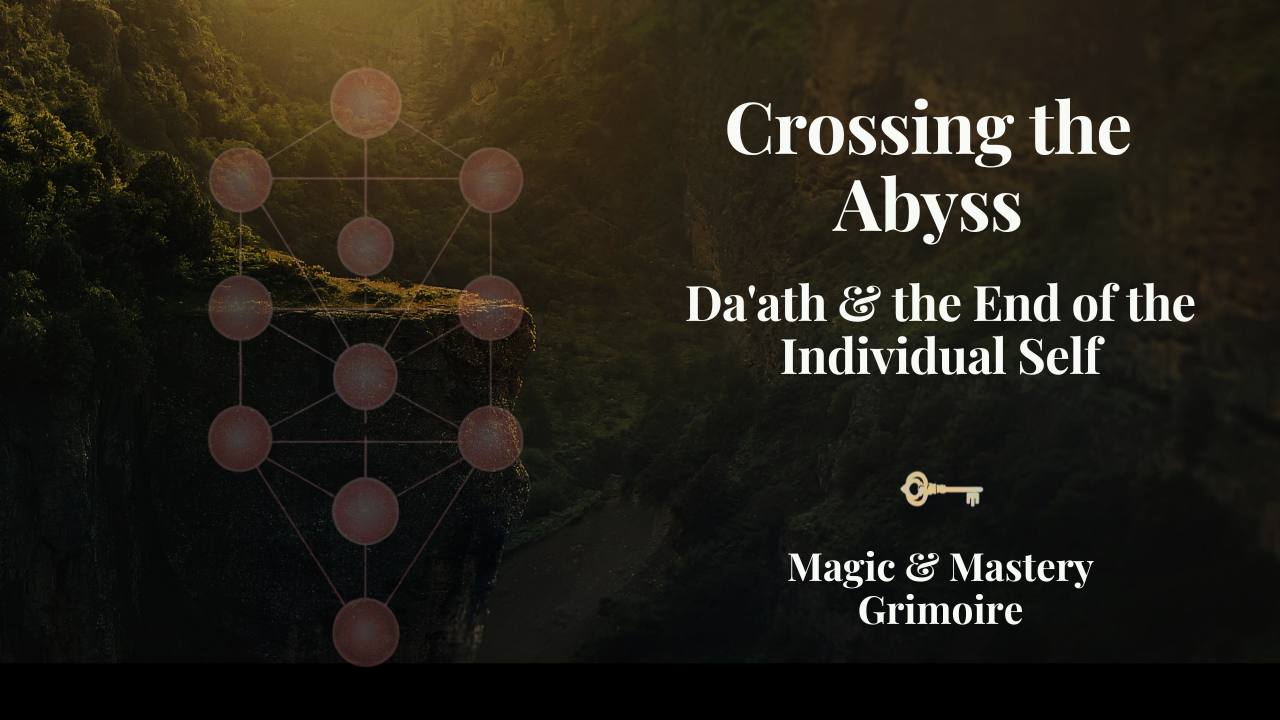
There's a moment in the study of the Tree of Life when the diagram stops making comfortable sense. You've been working your way up — Malkuth, Yesod, Hod, Netzach, Tiphareth, Chesed, Geburah — and then you hit a gap. Not another Sephirah. Not a path. A gap. Something the tradition marks on the map with unusual seriousness and then, depending on the text you're reading, either goes very quiet about or starts speaking in language that sounds increasingly like it cannot quite be said.
That gap is the Abyss. And understanding what it is — and what crosses it — changes how the entire Tree reads.
Three Thresholds
Before the Abyss, it helps to understand that the Tree has not one threshold but three, each one marking a shift in the nature of consciousness itself. An essential state change, if you will.
The first is the veil of physicality, located between Malkuth and Yesod. Crossing it is the realization that you are not only a physical body moving through a flat material world — that you have thoughts, emotions, an inner landscape that is as real as anything you can touch. Most people cross this veil, or at least partially cross it, simply by paying genuine attention to their inner life. It's the beginning of self-awareness. Crossing it is a big deal. It just doesn't feel like it afterward, because once you've crossed it, you can't remember what it was like not to have.
The second is called the Parochet — the veil between the personality level of the Tree and Tiphareth, the seat of the Higher Self. This is the threshold the ego finds considerably more disturbing than the first. Below the Parochet, everything is familiar: your thoughts, your emotions, your assembled sense of who you are. Above it, experience becomes different in kind. Something other than the ordinary mind starts to come through. The ego's response to this is typically to tighten its grip — to insist that what's happening is something it already understands, to colonize the experience, to maintain authorship. The crack where the light comes in is not the ego's favorite architectural feature.
The third threshold is the Abyss. And this one is in a different category entirely.
What the Abyss Actually Is
The Abyss is the gulf between the lower seven Sephiroth — from Malkuth up through Chesed and Geburah — and the Supernal Triangle at the top: Kether, Chokmah, Binah. It separates what Hermetic Qabala calls Microprosopos, the lesser countenance, from Macroprosopos, the greater countenance. In plain language: it is the boundary between the realm in which individual identity is possible and the realm in which it is not.
In other words, below the Abyss, consciousness operates through some version of I. Even at Chesed, the highest Sephirah accessible to human consciousness while retaining a sense of self, there is still an experiencer doing the experiencing, a self doing the ascending. Above the Abyss — in the Supernal Triangle — the I has dissolved. What remains is not a smaller, more refined self. What remains is something that cannot be described from the inside because there is no inside left to describe from.
This is what makes the Abyss qualitatively different from the veils below it. The Parochet asks the ego to step back and allow something larger to come through. The Abyss asks the ego to stop existing. Not temporarily, not as a meditative state you return from — but as a permanent reorganization of what you understand yourself to be.
The tradition calls this ego death. And the ego will do, it turns out, nearly anything to prevent it.
Da'ath: The Non-Sephirah
In the visual space where the Abyss sits on the Tree of Life, there is sometimes depicted what appears to be an eleventh Sephirah: Da'ath. Its name means Knowledge — specifically the kind of knowledge the Hebrew word da'at implies: not theoretical knowledge, not secondhand knowledge, but the gnosis that comes from direct experience. Biblical Hebrew uses the same word for intimate union. This is knowledge that changes you by entering you.
Da'ath is not a Sephirah in the same sense as the other ten. It has no fixed position on the map, no god name of its own, no stable correspondences. Some traditions call it the empty room, the condemned cell, the monastic cell. Others call it the bridge across the Abyss, or simply the void. What it points to is not a destination but a process — the change in state of consciousness required to cross the gap between dualistic reality and non-dual awareness.
It marks the place where all the symbols run out. Every other Sephirah can be approached through pathworking, meditation, correspondence work, directed ritual. Da'ath cannot be approached that way because approach implies a self doing the approaching, and the experience Da'ath represents is precisely the dissolution of that self. It can be pointed at. It cannot be described from the other side by someone who has come back, because what comes back is no longer the self that went in.
The Structure of the Crossing
The paths that cross the Abyss — what the Hermetic tradition calls the paths of the divine self — are the most abstract on the Tree. They connect the Supernal Triangle down to Tiphareth and, through Tiphareth, to the rest of the lower Tree. Qabalists approach these paths with considerable humility: they can be explored through symbol and analogy, contemplated through Tarot imagery, pointed toward in pathworking — but they cannot be fully grasped by the ordinary mind because the ordinary mind is precisely what they are asking to be released from.
Three paths cross directly: Gimel, the longest path on the Tree, running from Kether straight down to Tiphareth and named the Guardian of the Abyss; Zayin, called the Sacred Marriage, connecting Binah to Tiphareth; and He, called the Collective Consciousness, connecting Chokmah to Tiphareth. The two outer paths — Cheth connecting Binah to Geburah, and Vav connecting Chokmah to Chesed — are described as the cosmic framing structure, the architecture that holds the whole together.
The path of Gimel is associated in Tarot with the High Priestess — the figure who sits between the pillars, who knows but does not speak, who guards the threshold without opening it prematurely. The crossing she represents is the most direct route across the Abyss and perhaps the most vertiginous: the mystical dissolution of the self as an individual spark of the divine, merging back into undifferentiated oneness. The camel of her Hebrew letter — the creature uniquely evolved to endure the desert crossing, needing less water than any walking mammal — is the traditional image for whatever in us can survive that journey.
The Crossing and What It Costs
Hermetic Qabala is consistent about what crossing the Abyss requires and what it produces.
What it requires: everything. The myth of Inanna descending into the underworld — relinquishing her seven badges of sovereignty at each gate, arriving at the lowest level stripped of everything she was — is one of the oldest images for this process. You enter the Abyss carrying your adepthood, your accomplishments, your carefully developed spiritual identity, your hard-won understanding of the Tree. None of it survives the crossing. Not because it was wrong, but because it was yours, and there is no yours on the other side.
The ego, naturally, objects to this strenuously. If the ego kicked and screamed at the Parochet, its response to the Abyss is more extreme. It will generate elaborate spiritual experiences that feel like crossing while actually being the ego's best simulation of crossing. It will produce mystical states, visions, feelings of expansion and unity — all real, all valuable, none of them the Abyss. The authentic crossing cannot be faked because there is no self left to fake it.
What does crossing it look like? Well, in the Golden Dawn grading system, successfully crossing the Abyss and reconstituting on the other side confers the degree of Master of the Temple. The tradition's language for what comes back is striking: not a more evolved individual, but something that has touched non-dual awareness and returned to operate in the dualistic world from that perspective. You will never see yourself in the same way again — because the self that did the seeing has been permanently reorganized.
What This Means Before You Get There
Most practitioners, even serious ones with decades of work behind them, are nowhere near the Abyss in the full technical sense. This is fine. The paths of the lower Tree — the personality work, the astral triangle, the ethical triangle, the approach to Tiphareth — are not prerequisites to rush through. They are the work. They are what build the capacity that crossing will eventually require.
But understanding the Abyss now, before you're anywhere near it, does something useful. It reframes the whole Tree. Every veil you've crossed, every level of consciousness you've integrated, every worked-through pattern and developed capacity is preparation for a crossing that may or may not come in this lifetime. The whole structure is oriented toward something. The map has a direction.
It also explains something about the Hermetic insistence on doing the work rather than just knowing about it. Da'ath is not called Knowledge because you learn it. It's called Knowledge because it can only be entered. The gap cannot be theorized across. It has to be crossed, and what carries you across is the accumulated development of everything below it — not as intellectual attainment, but as genuine change in who you are.
The empty room is waiting. Most of what the Tree is teaching you is how to be ready to walk into it and not turn back.