Why Does Kabbalah Have Three Spellings?
Apr 07, 2026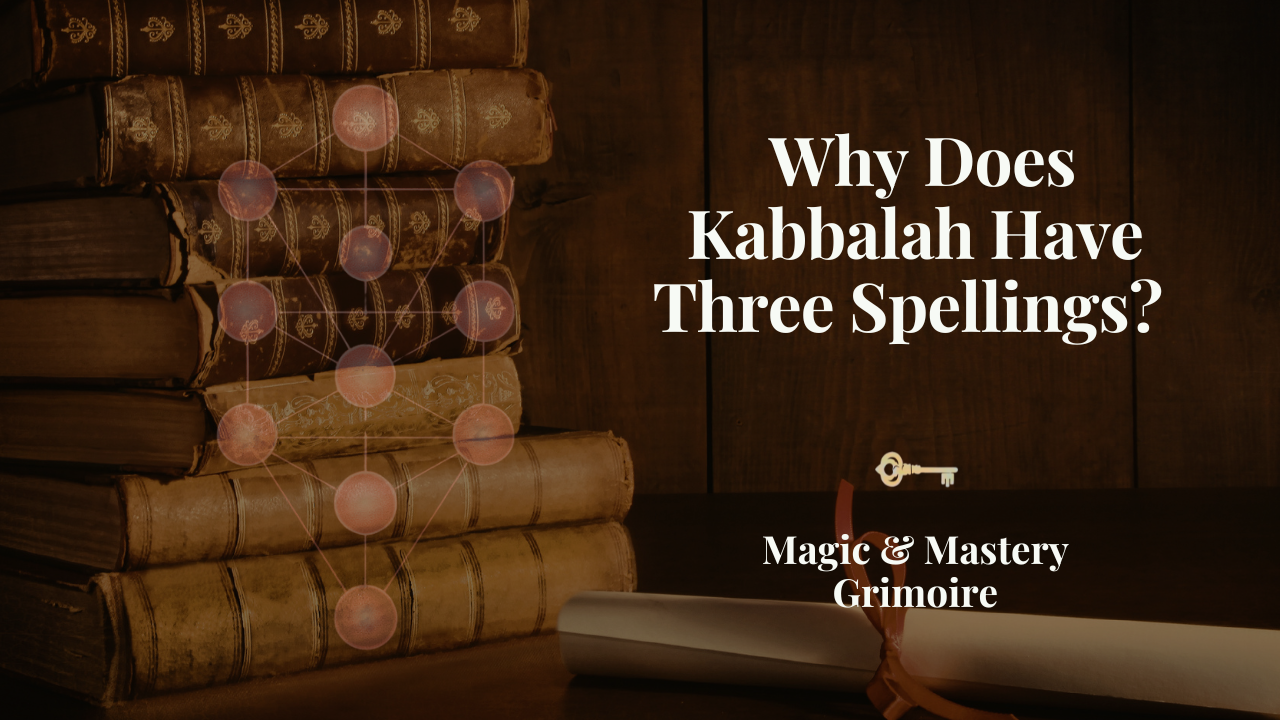
Kabbalah, Cabala, Qabala. Three spellings, and they're not competing attempts to transliterate the same word. They're a convention — imperfect, not universally followed — but the fastest shorthand available for pointing to three genuinely different traditions.
The underlying idea all three traditions are working with — that reality flows outward from a single unified source into increasing multiplicity and density, a process called emanation — is older than any of them. You find it in Egyptian cosmology, in Hellenistic philosophy, and in Neoplatonist dialogues. In third-century Alexandria, Jewish, Greek, Gnostic and Hermetic thinkers were all in the same room, arguing about how the One becomes the Many.
But by the 5th century, the Church in Europe shut down the conversations. Gnostic and Hermetic ideas were declared heretical, and the institutional project to stamp them out began in earnest. It didn't entirely succeed — it never does — but it did scatter the tradition into several underground streams.
Kabbalah (with a K) emerged from Jewish mystics working in private enclaves in Islamic Spain. With access to the mystic Jewish text the Sefer Yetzirah, and Hermetic texts through Arabic translations, they developed the emanation framework into the most rigorous and structured form it had ever taken, the Tree of Life. Built around the Hebrew alphabet and scriptures, it crystallized somewhere between the sixth and ninth centuries. It remains a living religious practice today, which is a large part of why other traditions kept finding their way back to it.
Cabala (with a C) is what happened when the Renaissance encountered the Kabbalah. The idea or emanations never entirely left Christian culture — Dante's Divine Comedy is essentially a Tree of Life as narrative, descending through the planetary spheres in Hell and ascending back through them in Paradise. But the Italian philosopher Giovanni Pico della Mirandola made it explicit, using Kabbalistic architecture to reconcile Platonic philosophy with Christian theology.
Qabala (with a Q) is the Hermetic tradition recognizing itself. When Renaissance and later Hermetic magicians encountered the Kabbalistic Tree of Life, they weren't discovering a foreign system either — they were finding a familiar idea in a more rigorous form. The emanation framework had always been part of the Hermetic tradition. Kabbalah had simply done the most thorough job of mapping it. The Hermetic magcians stripped the Tree of Life of its specifically Jewish and Christian theological commitments, and folded it back into Western esoteric magic. It was central to the work of German occultist Heinrich Cornelius Agrippa, the Rosicrucians, the French esotericist Eliphas Lévi, and, finally, the Hermetic Order of the Golden Dawn.
What the Spelling Doesn't Guarantee
One honest caveat: not everyone uses the K/C/Q convention. You'll find serious Hermetic practitioners who write "Kabbalah" and mean exactly what this post means by "Qabala." You'll find books that use all three spellings interchangeably. The convention is a useful signal, not a law.
What matters is the underlying distinction. Are you working within a living Jewish religious tradition, with all the obligations and context that it carries? Or are you working with a Hermetic system — a functional map of consciousness used by Western magical practitioners for centuries?
Jewish Kabbalah and Hermetic Qabala are different practices aimed at different ends. The Q is simply a way to clarify which conversation you're entering.
Why the Q Matters to You
Here's the practical question: if you're a practicing magician, astrologer or Tarot reader, which of these traditions is actually embedded in the tools you're already using?
The Q one.
Every grade of Golden Dawn initiation is mapped onto the Tree of Life. The Rider-Waite-Smith Tarot — the deck that sits on the table of probably every experienced reader you've ever met, and the template for most decks published since — was designed with the Sephiroth and the twenty-two paths explicitly in mind. Arthur Waite sat down with each card and made deliberate decisions about where it sat on the map. That's not historical trivia. It means the symbolic language of your deck is encoded in Hermetic Qabala, whether you knew it or not.
The same is true for the Western magical tradition more broadly: the planetary correspondences, the elemental system and the ritual structures that run through ceremonial magic from Agrippa onward. You can't fully understand what you're doing with those tools without understanding the Qabalistic framework underneath them. It's the wiring diagram. The tools are what's plugged into it.