What the March 2026 Blood Moon Reveals
Jan 21, 2026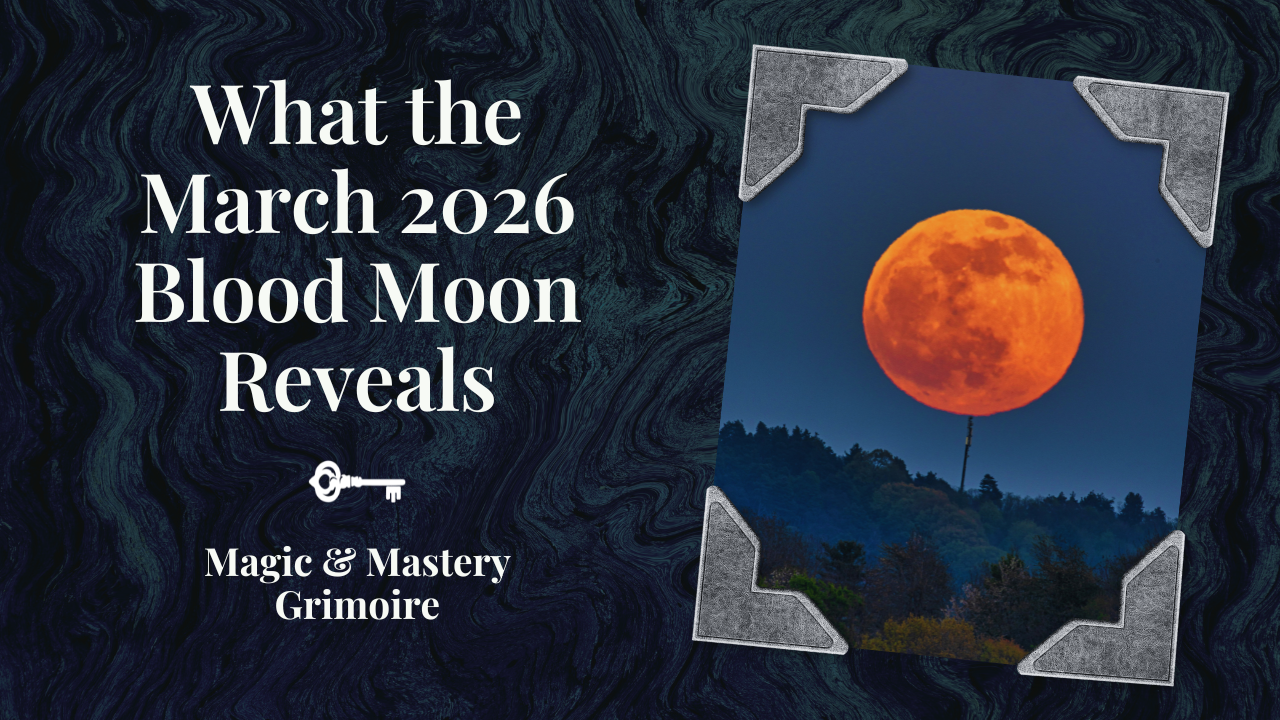
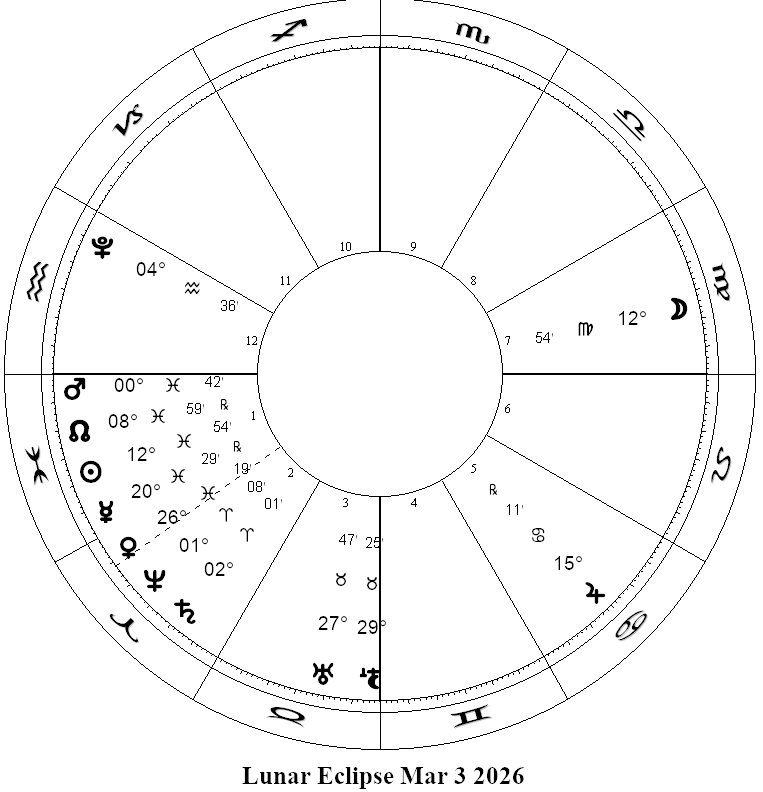
The February-March 2026 eclipse season ends with a total lunar eclipse at 12°54′ Virgo — a Blood Moon that brings accumulated strain into full view.
Lunar eclipses don’t initiate new chapters. They reveal where a story has reached its limit. This one arrives after months of mounting pressure around work, care, health, and emotional labor, exposing systems and responsibilities that have been maintained long past the point of sustainability.
Rather than delivering a dramatic rupture, this eclipse focuses on consequence. It highlights the quiet costs of endurance: the toll of overextension, unexamined obligation and roles held together by habit rather than vitality. What it asks for is not vision or reinvention, but discernment — a clear-eyed assessment of what can still be maintained, and what must finally be set down.
The clarity this eclipse brings is not abstract or ideological. It shows up through lived experience, practical limits and signals that are increasingly hard to ignore.
Full Moon Lunar Eclipse Astrological Summary
Time & Date: Tuesday, March 3, 2026 @ 6:38 a.m. Eastern U.S.
Moon Zodiac Sign: Virgo
Moon Speed: Normal
Moon Declination: In bounds
Lunar Mansion: 13 Al Awwa (nickname: the Alchemist)
Aspects to the Sun/Moon: Sun & Moon trine Jupiter in Cancer (retrograde)
Moon’s Ruler: Mercury in Pisces (in detriment & fall)
Aspects to the Moon’s Ruler: none
Blood Moon: Total Lunar Eclipse
This is a total lunar eclipse, meaning the Earth moves directly between the Sun and the Moon, casting the Moon fully into shadow. Rather than extinguishing light, a total lunar eclipse transforms it. The Moon darkens and appears red—hence the name Blood Moon. It’s the third in a series of Blood Moon eclipses that began in March 2025.
Astrologically, total lunar eclipses function like supercharged Full Moons. They bring culmination and exposure. Emotional, relational or collective dynamics that have been building over time move fully into view. What has been managed quietly becomes visible, and reactions tend to be strong, public or difficult to contain. Not because something new is beginning, but because what already exists can no longer be held back.
Geography & Visibility
This eclipse is most visible across Western North America, the Pacific region, East Asia, Australia and New Zealand, where it appears high in the sky. In central and western North America, the eclipse unfolds in the predawn hours. In the eastern United States, the eclipsed Moon sets near sunrise, allowing only partial visibility before it slips below the horizon. (This makes it the second eclipse in a row occurring at the horizon line in Washington, D.C.)
While visibility varies by location, lunar eclipses tend to register less through overt spectacle and more through shared emotional response. Their influence spreads through collective mood and lived conditions rather than dramatic visuals.
Saros Cycle 133: Visibility Through Consequence
This eclipse belongs to Lunar Saros series 133, a lunar eclipse family that began in May 1557, well into the aftermath of the Protestant Reformation. By this point, the dramatic breaks had already occurred. What remained was the slower, more difficult phase: prolonged doctrinal conflict, uneven efforts at consolidation, public unrest and the growing recognition that previously unquestioned authorities would not be restored intact. The emphasis was no longer on shock, but on consequence.
The series entered its central phase in Dec 1917, coinciding the continued. rise of mass literacy, labor movements, public health reforms and increased attention to social conditions that had long been ignored or kept out of view. During this phase, lived experience began to carry more weight than abstract ideology. Patterns of inequality, exploitation and systemic failure became harder to dismiss once they were broadly visible and publicly documented.
In 2026, Saros 133 continues its mature phase. As a total lunar eclipse, this event emphasizes reckoning rather than revelation. What comes into view is not new—but it is no longer avoidable. The work of this Saros family is not to initiate change, but to make the cost of delay unmistakable, pressing unresolved realities into full awareness until they must be addressed.
South Node Eclipse: Culmination & Release
This is a South Node lunar eclipse, emphasizing completion rather than initiation. South Node eclipses bring patterns to their natural endpoint, exposing what can no longer be sustained.
Rather than pointing toward a clear replacement, they force recognition. Systems, habits or emotional investments reveal their fatigue. Something becomes obvious precisely because it is ending. The work here is not a dramatic release but an acknowledgment—setting down what has reached diminishing returns so that balance can be restored.
Eclipse Zodiac Sign: Virgo–Pisces
With the Moon in Virgo opposite the Sun in Pisces, the luminaries activate the Virgo–Pisces axis. Eclipses here focus attention on the tension between discernment and diffusion: between what can be named, repaired or maintained, and what dissolves into ideals, narratives or emotional fog.
Virgo eclipses surface questions of skill (labor), health and ecology—especially where those systems have been strained by unrealistic expectations or unexamined sacrifice. With the Sun in Pisces, beliefs or stories that once carried meaning may lose traction, making avoidance harder to sustain.
This axis does not favor grand vision. It favors triage. What works can be strengthened. What relies on confusion, martyrdom or denial begins to fall away. The emphasis is not on perfection but on clarity.
Lunar Mansion: Al Awwa | The Alchemist
This eclipse falls in the 13th Lunar Mansion, Al Awwa, which I nicknamed the Alchemist. Its energy favors passionate and creative union — not in the sense of permanence, but in the sense of experimentation. This is a lunar mood that invites mixing, testing, and combining elements that don’t usually go together, just to see what happens.
Under Al Awwa, manifestation works through trial and recombination. It’s not an ideal moment for locking in long-term commitments, but it can be very effective for breaking out of ruts or habitual patterns. Small experiments, temporary collaborations, or exploratory changes can open unexpected possibilities, even if the results aren’t meant to last. The value here is movement — discovering what becomes possible when familiar boundaries loosen.
Eclipse Ruler: Mercury in Pisces
The ruler of an eclipse also has something to say about how the eclipse is processed. At the time of the eclipse, Virgo’s ruler, Mercury, is in Pisces, where it is both in detriment and fall.
This places the ruler of analysis and communication in a sign oriented toward intuition and permeability. The result is friction between the need to assess and repair (Virgo) and the tools available to do so (Pisces). Information may be incomplete, emotionally colored or difficult to verify—even as practical decisions feel unavoidable.
This eclipse does not reward tidy solutions. Instead, it clarifies limits: what cannot be fixed through analysis alone, and where systems have relied on hope or ambiguity rather than sustainable structure.
Aspects to the Eclipse
Jupiter retrograde in Cancer forms a trine to the Pisces Sun and a sextile to the Virgo Moon, offering support—but not neutrality. In Cancer, Jupiter expands bonds of loyalty, protection and belonging. Its retrograde motion turns those themes inward, emphasizing memory, precedent and emotionally justified boundaries.
Responses to what this eclipse reveals are shaped less by abstract principle and more by questions of “who is considered ours.” Care and protection are available, but unevenly distributed. This configuration can provide real ballast within established circles, while simultaneously sharpening lines of exclusion. Repair efforts favor familiarity over reform.
Who this Eclipse Affects Most
This eclipse is felt most strongly by those with planets or angles in the mutable signs, especially Virgo and Pisces near 10°–16°. Virgo placements may encounter strain around work, health or responsibilities that have quietly become overwhelming or unsustainable. Pisces placements may experience exhaustion or disillusionment when ideals no longer align with lived reality.
Gemini and Sagittarius placements may feel the effects indirectly, through competing demands or shifting narratives that require adaptation without clear guidance. More broadly, this eclipse highlights stress within labor, health, service, logistics and organizational systems—areas where maintenance has replaced growth and effort no longer yields proportional return.
The Road Ahead
This eclipse does not resolve what it reveals. Instead, it sets a threshold. In the weeks and months that follow, the consequences of overextension, misalignment, and unexamined obligation continue to surface—sometimes gradually, sometimes through unmistakable emotional or physical signals. What has been exposed now requires a response, even if the next steps remain uneven or incomplete.
Because this is a South Node lunar eclipse, the work ahead is not about replacement or reinvention. It is about reduction. Simplification. Letting go of roles, expectations, or systems that have quietly drained vitality while offering diminishing returns. What clears in the aftermath creates space—not immediately for growth, but for stability and repair. The future opens not through vision alone, but through honesty about what can no longer be carried forward.


