The Occult Roots of Groundhog Day: Omens, Folk Magic & Winter’s End
Feb 01, 2026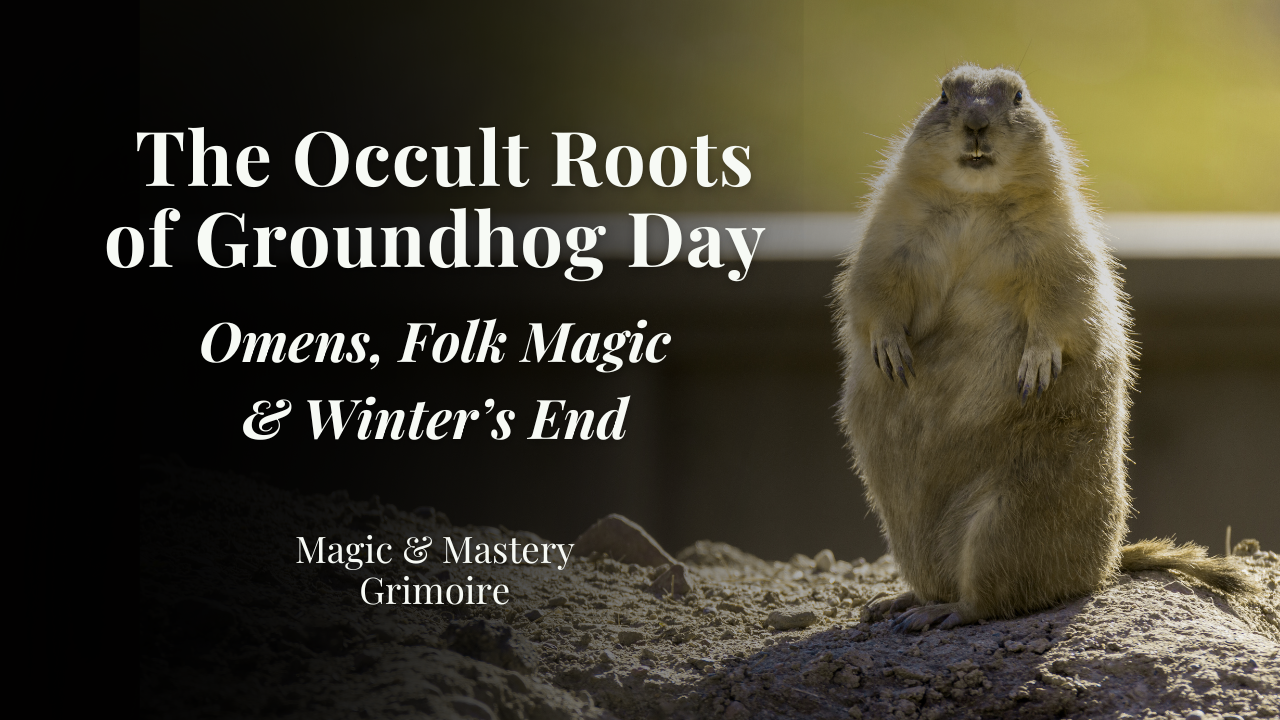
Groundhog Day is one of those holidays that looks like a novelty until you know what you’re looking at. On the surface, it is a lighthearted North American tradition involving a groundhog, a top hat and a weather prediction. Underneath, it is a remarkably intact piece of seasonal divination and folk magic that stretches back centuries.
Observed on Feb. 2 in the United States and Canada, Groundhog Day asks a single question: Is winter truly loosening its grip, or are we still in its grasp? The answer is delivered not by modern meteorology but by omen, a method of weather lore far older than forecasts and data models.
If the groundhog emerges from its burrow and sees its shadow, winter is said to continue for six more weeks. If it does not, spring is considered close at hand. While modern science dismisses the prediction as unreliable, the ritual's structure reflects a much older system of seasonal observation.
This is not random folklore. It is seasonal magic, preserved in plain sight.
Winter’s End, Spring’s Renewal
Groundhog Day arrives quietly in early February, when winter is no longer new but not yet finished. It marks the midpoint between the Winter Solstice and the Spring Equinox, a liminal moment in the seasonal calendar.
By early February, days may still be cold, but the return of light is visible. Daylength increases more quickly. For premodern societies, this was a time to celebrate the returning sun and to prepare for the agricultural season ahead.
The Celts called this time Imbolc, a name associated with ewe’s milk returning after the first lambs of the season are born. It marked the stirring of life beneath winter’s surface, a theme shared across many early spring festivals.
Imbolc traditions emphasize light, purification and preparation. Tools are cleaned. Candles are blessed. Homes are made ready. The coming agricultural year is assessed.
Similar seasonal observances existed across much of Europe. The Catholic Church incorporated these customs into its own calendar with Candlemas, a festival centered on the blessing of candles and the return of light. The Church fixed the date as Feb. 2, anchoring older seasonal rites to a Christian framework.
Omens for Winter’s End
Early February has long been the point when people begin asking the same practical question: How much longer will this last?
For agrarian communities, the question was not symbolic. Food stores were shrinking. Livestock care was harder in deep cold. The lengthening of daylight offered hope, but hope alone was not enough. People needed information. Early February became a time for careful environmental observation, watching for signs that winter was easing or preparing to persist.
In premodern societies, weather prediction relied on pattern recognition, symbolic timing and lived experience. These practices form a broad body of folk knowledge known as weather lore, in which specific dates are used to read signs about the coming season.
In German folk tradition, the weather on Candlemas was believed to foretell the remaining length of winter, making it an important date for seasonal divination. This is omen territory.
Hedgehogs and Badgers and Bears, Oh My
An omen is an event, object or phenomenon believed to be a sign or warning of future good or bad fortune, acting as a portent or foreshadowing a significant happening.
Animals were understood to be sensitive to seasonal shifts in ways humans were not. Across Europe, different animals served as early February weather omens depending on region. Hedgehogs, badgers and bears were common choices, all known for hibernating and emerging in response to subtle changes in temperature and light.
The logic was consistent. If the sun was strong enough to cast a clear shadow, skies were clear and cold persisted. The animal returned to its burrow and winter endured. If the sky was overcast, conditions were believed to be moderating. The animal stayed out. Spring was approaching.
This logic appears across English, French, German and Latin weather sayings. One well-known English couplet reads:
If Candlemas is fair and clear
There’ll be twa winters in the year.
In German-speaking regions, the original Candlemas forecasting animal was the bear. Bears hibernate, and their emergence served as a meaningful seasonal marker.
But as bears became scarce in parts of Europe, the role shifted to the badger. In German, Dachs refers to the badger, and Candlemas was sometimes called Dachstag, or Badger Day. If the badger emerged and saw its shadow, it returned to its burrow and winter continued.
The Birth of Groundhog Day
This tradition arrived in North America with German-speaking immigrants who settled in Pennsylvania in the 18th and 19th centuries. These communities, later known as the Pennsylvania Dutch, preserved European folk practices while adapting them to a new landscape.
In Pennsylvania, hedgehogs were scarce. Groundhogs were not. The logic of the tradition remained intact even as the animal changed. Groundhogs burrowed deep into the earth and emerged at roughly the same point in the seasonal calendar. For farming communities, they were reliable indicators of soil conditions and temperature shifts.
By the mid-1800s, references to groundhog-based weather prediction appear in Pennsylvania newspapers and local records. What had once been a household or village observation became a shared public event. The omen was no longer simply observed. It was announced.
This shift marks the moment when Groundhog Day begins to resemble what we recognize today: a local folk practice becoming a regional tradition, sustained through repetition rather than belief alone.
Groundhog Day as Living Folk Magic
One of the most striking aspects of Groundhog Day is how much of it has survived intact. Folklorists recorded these sayings throughout Pennsylvania Dutch Country in the 19th and early 20th centuries.
Despite industrialization, urbanization and scientific weather forecasting, the ritual continues. Towns gather. An animal is presented. A proclamation is read.
In Punxsutawney, Pennsylvania, the ceremony has become elaborate and theatrical, centered on the semi-mythical figure of Punxsutawney Phil. Scrolls are read. Titles are bestowed. An inner circle interprets the omen.
Other towns across the United States and Canada have developed their own versions, sometimes using live animals, sometimes taxidermy, sometimes mascots. The form varies. The structure remains.
All of this survives despite modern commentary that often focused on whether groundhog predictions are accurate. Studies routinely show they are not statistically better than chance. That critique misunderstands the practice.
From a folkloric perspective, omen reading is not only about precision. It is about relationship. It connects people to seasonal time, animal behavior and shared cultural memory. The value of Groundhog Day lies in its role as a seasonal checkpoint, not as a forecast.
Seen through this lens, Groundhog Day is not a joke holiday. It is living folk magic hiding in plain sight. This pageantry is not decoration. It is ritual formalization. It preserves the seriousness of the act even as it entertains.
Okay, the groundhog does not predict the weather in the modern sense. Instead, it does something more profound. It links us to our ancestors. And it marks the moment when we pause, observe and ask whether winter is ready to release us yet.
And that is something we all want to know.
Ready to Tend Your Flame?
Whether you light candles at dawn, cleanse your home with intention or whisper prayers over seeds not yet planted, Imbolc season invites you to trust the unseen work of becoming. To honor the light not because it is strong — but because it has returned.
The Magic & Mastery community gathers to celebrate Imbolc and the turning points of the witch’s year. Together, we honor the thresholds that shape our lives, one sacred season at a time.