The Weird History of Beltane & May Day
Apr 21, 2026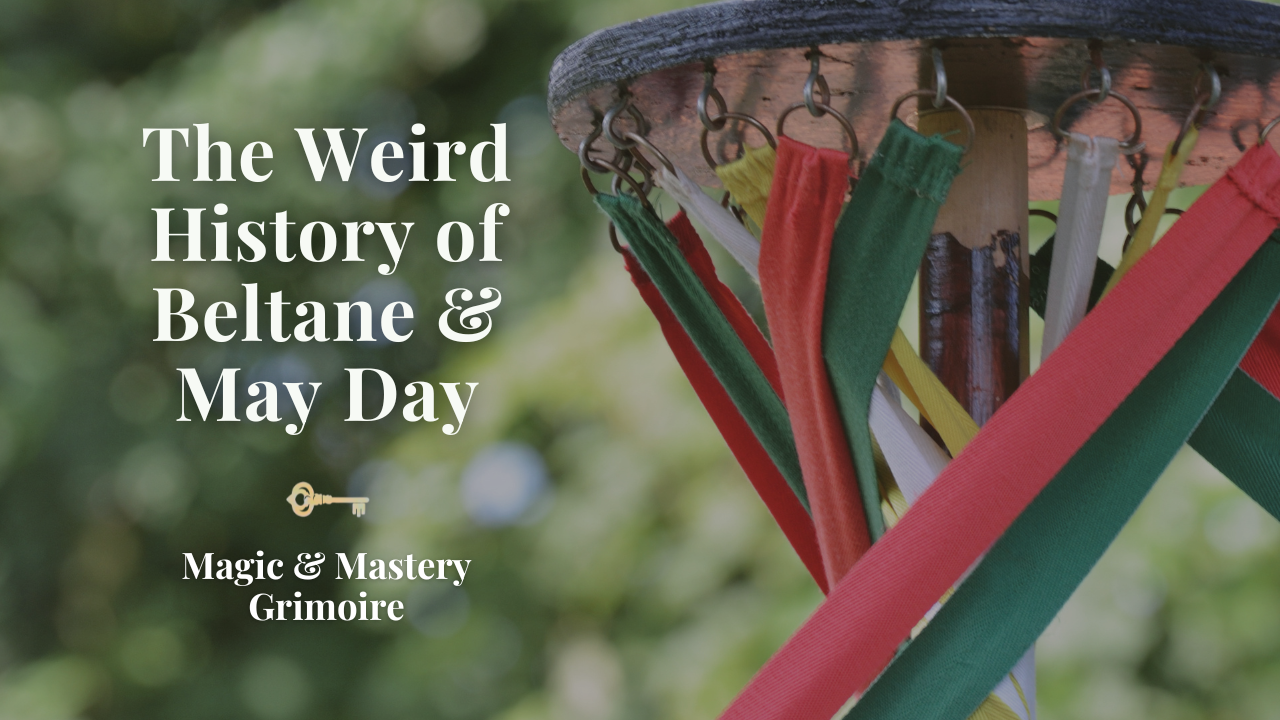
Most people who celebrate Beltane know the basics. Fire. Flowers. The Maypole. What they don't always know is how weird, contested and surprisingly modern some of the history actually is. Here are some of the stranger threads running through May Day.
"Mayday" the Distress Call Has Nothing to Do With May Day
If you've ever wondered whether the international distress call "Mayday" has anything to do with the ancient spring festival, the answer is no. The actual origin is much stranger.
The “Mayday” distress call was coined in 1923 by Frederick Stanley Mockford, a radio officer at Croydon Airport in London. He needed a word that would be clearly understood by pilots and ground crew in an emergency, many of whom were flying between England and France. He chose "Mayday" from the French m'aider — a shortening of venez m'aider, meaning "come help me."
So the word that means "everything is on fire and I need help immediately" comes from a French request for assistance, not from a Celtic fire festival. The fact that it sounds exactly like the spring celebration is a coincidence with no deeper meaning.
(Though it is worth noting that "everything is on fire" is also, in a completely different sense, an accurate description of Beltane.)
May Morning Dew Was Considered Magic
Across Ireland, Scotland and England, washing your face in the dew gathered on May morning was believed to confer beauty, luck and youthfulness. Specifically, pre-dawn dew, collected before the sun rose fully on May 1.
This wasn't a fringe belief — it was widespread enough to be documented across multiple centuries and multiple countries. Samuel Pepys recorded his wife going out to collect May dew in 1667. It showed up in folk poetry. It persisted in rural areas well into the 19th century.
The magical logic is consistent with Beltane's broader framework: the liminal moment — the threshold between April 30 and May 1 — carries particular power. What you gather at the exact turning point holds the season's energy in concentrated form.
Whether or not you believe in the magic, going outside before dawn on May morning to notice the world before it gets busy is not a bad practice.
The Fairy Danger Was Taken Seriously
In Irish and Scottish tradition, Beltane wasn't just a celebration — it was also a period of genuine supernatural risk. The fair folk were particularly active at liminal times, and Beltane was one of the two most liminal points in the year.
This wasn't decorative folklore. Precautions were practical and specific. Cattle were driven through fires to protect their milk from being stolen by fairies. Rowan crosses were worn and fastened over doorways on the Isle of Man. Offerings of food and milk were left at fairy trees and sacred wells. Neighbors were not given milk on May Day because it was feared the gift would transfer the cow's milk to the neighbor's herd through fairy interference.
The underlying belief: at threshold times, the boundary between the visible and invisible worlds becomes genuinely permeable. What you do and don't do at those moments has real consequences.
Modern practitioners tend to soften this into something charming. The original tradition treated it as a matter of practical risk management.
Maypole is More than A Fertility Symbol
The Maypole looks like a folk tradition. It's actually a cosmological diagram.
A vertical pole planted in the earth, with ribbons extending outward to be woven by dancers moving in opposing directions — this is the world-axis made physical. The vertical pole connects earth and sky, root and crown, the material and the spiritual. The ribbons being woven by dancers moving in opposite directions represent the intertwining of opposing forces: masculine and feminine, individual and community, this year and the next.
The weaving of the ribbons is the magic. Not a symbol of the magic. The thing itself. When the dance is done and the ribbons are wound tight around the pole, the intentions of everyone who danced have been literally woven together and bound to the earth.
Maypole Controversies
Nevertheless, the Maypole's reputation as a symbol of fertility and sexuality was not subtle, and it wasn't lost on anyone. Philip Stubbes, a 16th-century English pamphleteer, described May Day celebrations with barely concealed horror, reporting that of the young people who went "a-Maying" into the forests overnight, scarcely a third returned home with their virtue intact.
In 17th-century England, the Puritans took one look at the Maypole and declared it an abomination. The dancing, the ribbons, the general atmosphere of physical celebration — all of it had to go. Maypoles were cut down across Britain. In 1644, Parliament officially banned them altogether.
It didn't work. The Maypole came back the moment the political winds shifted, and it has never entirely gone away. There are villages in England with permanent Maypoles on the green to this day.
What the Puritans were really objecting to wasn't the pole. It was the body. The celebration of physical pleasure, communal joy and seasonal vitality as something sacred rather than something to be suppressed. That argument didn't end in the 17th century. It's still running.
Beltane Almost Disappeared Entirely
By the 20th century, the traditional Beltane celebrations in Ireland and Scotland had largely died out. What we now call Beltane — the fire festivals, the Maypole, the wheel of the year structure — was substantially reconstructed and revived by the modern Wiccan and neopagan movements from the mid-20th century onward.
This is sometimes treated as a scandal, as if only unbroken ancient lineage counts as authentic. It isn't. Every living tradition gets interrupted, lost and recovered. The Edinburgh Beltane Fire Festival — now one of the most spectacular May celebrations in the world — was revived in 1988 after a gap of nearly 150 years.
The season doesn't care about the paperwork. It keeps generating the same human response regardless of whether there's an unbroken institutional record behind it.
The fires get lit. They will always get lit. We all live under the same sky.
International Workers’ Day and Beltane Land on the Same Day
International Workers' Day — May Day — falls on May 1 specifically because of the Haymarket affair in Chicago on May 4, 1886, when workers striking for an eight-hour workday were met with violence. The international labor movement chose May 1 as a day of global solidarity in their memory.
The date wasn't chosen for its pagan associations. But the convergence is worth sitting with. The season of collective generativity — when the earth is doing its most visible work of bringing things into being — became the day workers chose to assert their own power to produce and create. The same seasonal energy that drives seeds into the ground and flowers into bloom was claimed by the people who do the labor of turning that natural abundance into a world.
Nobody planned that correspondence. The season made it anyway.
Mother's Day Has Ancient Roots Nobody Talks About
Mother's Day in the United States falls on the second Sunday of May — squarely in Beltane season. The modern holiday traces to activist Anna Jarvis, who campaigned for a national day honoring mothers after her own died in May of 1905. President Woodrow Wilson made it official in 1914.
But the impulse is considerably older than Anna Jarvis. Spring festivals honoring mother goddesses go back to the classical world and beyond — Cybele in Anatolia and Rome, Rhea in Greece — celebrations of feminine generativity timed for when fertility returns to the land. The Catholic Church even placed its own celebration of the Virgin Mary in May.
(Ironically, when Mother's Day began, Catholic priests complained that it interfered with their May devotions to Mary — a holiday that had itself been introduced specifically to displace older pagan celebrations of the season.)
Earth Day Falls in Beltane Season, Too
Earth Day — April 22 — wasn't chosen for its pagan associations either. Sen. Gaylord Nelson picked the date in 1970 to maximize college campus participation, landing it neatly between spring break and final exams. Practical logistics, not seasonal magic.
And yet. The day Americans chose to assert their collective responsibility for the living world — to show up in millions and say the earth matters — lands squarely in Beltane season. The same weeks when ancient communities were lighting fires to honor the fertility of the land, modern Americans were marching to protect it.
Nobody planned that correspondence either. The season keeps making it anyway.
More Beltane Resources
Beltane and Other High Spring Celebrations →
Beltane Symbols & Correspondences →
Beltane Rituals for Passion & Presence →
Beltane Recipes to Cook for the Feast →