What Are the Three Pillars of the Tree of Life?
Apr 09, 2026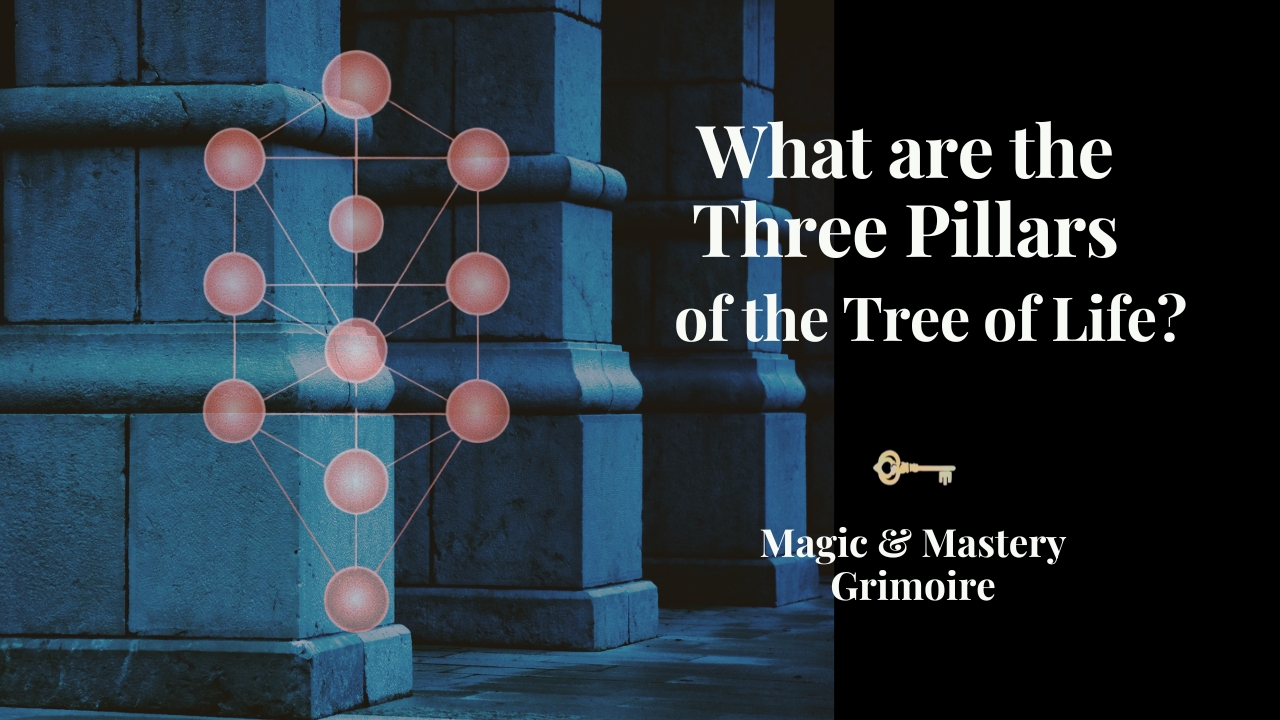
The Tree of Life is often described as ten circles connected by twenty-two lines. That's accurate but incomplete. Look at the arrangement more carefully and a different structure emerges: three vertical columns, running from top to bottom, each one expressing a distinct quality of reality.
These vertical paths are called the Three Pillars. And they're arguably the most practically useful structure on the entire Tree.
The Pillar of Mercy, or Force
The right pillar contains Chokmah, Chesed and Netzach. Three Sephiroth that share a common quality: they're all expansive, outward-moving, generative. Chokmah is the first stirring of divine force, the pure impulse to extend into the cosmos. Chesed is the loving kindness that underlies creation — expansive, unconditional, the energy that wants to give. Netzach is the life force in nature, the emotional and instinctive drive, passion before it's been named or contained.
Force. Movement. Expansion. Everything on the right pillar wants to pour outward.
The Pillar of Severity, or Form
The left pillar contains Binah, Geburah, and Hod. These are the contracting, structuring, limiting energies — and the word "limiting" here isn't a criticism. Form is what makes force usable. Binah is the great container, the acceptance of limits, the understanding that time and birth and death are the conditions of existence rather than its enemies. Geburah is discipline and strength — the force that prunes, focuses, and cuts away what's obstructing growth. Hod is the analytical mind, the organizing principle, the story and structure you put around experience to make it navigable.
Form. Structure. Containment. Everything on the left pillar gives shape to what the right pillar generates.
The Pillar of Equilibrium, or Consciousness
The middle pillar contains Kether, Tiferet, Yesod, and Malkuth — the central column running from the divine source straight down to the physical world. This is also called the Pillar of Consciousness, and for good reason: it's the path the practitioner actually walks.
Kether at the crown is pure divine unity. Tiferet at the center is the Higher Self — the divine spark within each person, the point of balance and beauty where all the forces of the Tree converge. Yesod just below is the astral body, the imagination, the dream-space where your experience crystallizes into what feels like reality. And Malkuth at the base is the physical world, where all of it must eventually land.
The middle pillar is where integration happens. It's where force and form meet and resolve into something a practitioner can actually work with.
Why This Matters
The three pillars aren't just a way to organize the Sephiroth. They're a diagnostic framework.
Most stuck patterns are imbalances between the outer two pillars. Too much force — emotion flooding without structure, desire running without discipline, creative energy with nowhere to land — is a right-pillar problem. Too much form — over-analysis, rigidity, thinking that circles without feeling, rules that have lost contact with life — is a left-pillar problem.
The middle pillar is the resolution. Not the suppression of either side, but the dynamic balance between them that allows both to function. Yesod stabilizes when both Netzach and Hod are contributing. The reality bubble holds its shape when force and form are in conversation rather than one dominating the other.
This is also why the Hermetic tradition describes the practitioner's path as the middle pillar work. You're not trying to eliminate passion or eliminate analysis. You're learning to hold both, and to move along the central column — from Malkuth through Yesod and Tiferet toward Kether — with both pillars functioning as they should.
The Tree didn't invent this dynamic. For every expansion, there's a contraction. For every left, a right. For every impulse to pour outward, something that gives it shape. That is just how living in spacetime operates. The Tree mapped it — with unusual precision, and unusual usefulness for anyone trying to work consciously with the forces that run through ordinary life.