What are Chesed and Geburah? The Balance of Mercy and Severity
Apr 15, 2026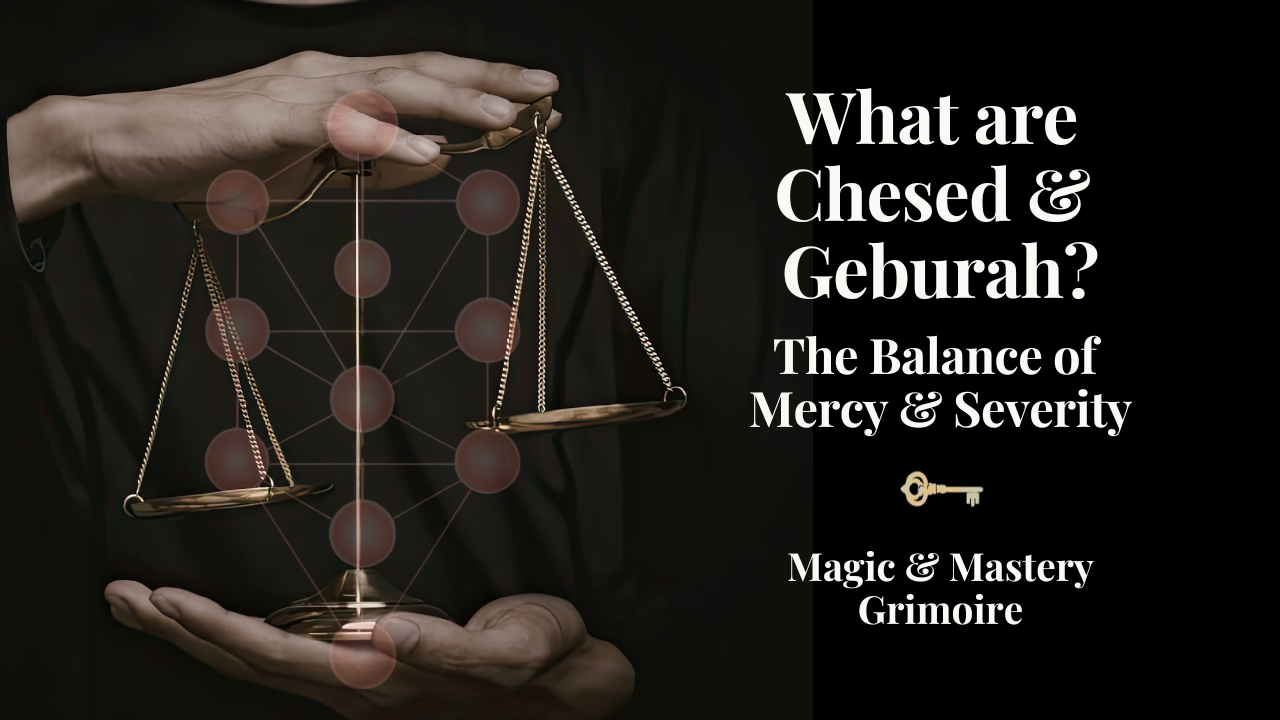
Most people are more comfortable with one of these scenarios than the other.
The person who gives endlessly and can't say no, who keeps expanding the project and adding one more idea and refuses to cut anything — that's someone who hasn't met Geburah yet, or who met it and ran in the other direction.
The person who lives by the rules and defends every boundary and prunes everything that isn't perfectly justified — that's someone who has lost contact with Chesed, or who never fully trusted it.
These are not personality types. They are two Sephiroth at the heart of the ethical triangle, and the tension between them is one of the most practically instructive dynamics on the entire Tree of Life.
Chesed, the Fourth Sephirah
Chesed sits at the center of the right pillar — the Pillar of Force — directly below Chokmah and directly above Netzach. Its name means Mercy, or Loving Kindness. Its planet is Jupiter. Its color is deep blue-violet. Its number is four.
It is the first Sephirah below the Abyss — the highest level of the Tree that human consciousness can reach while still maintaining a sense of individual self. Everything above it is the Supernal Triangle, the domain of the divine in its most abstract form. Chesed is where the divine impulse first takes shape as something a practitioner can actually work with.
The force that manifests in Chesed is love — but not love as emotion or attachment. The tradition is precise here: this is the love that the Buddhists call loving-kindness, the compassion from which the cosmos is created and sustained. Not romantic love. Not even human warmth, exactly — though human warmth is one of its expressions. The pure unconditional creative impulse that pours outward from the source. The force that wants to give, to build, to sustain.
Chesed is sometimes called the Hall of the Masters, or the sphere of the adepts — the level of consciousness associated with those who have done enough spiritual work to hold the full weight of unconditional compassion without collapsing under it or weaponizing it. The Bodhisattva of Mahayana Buddhism — the being who could transcend the wheel of incarnation but delays that reunion out of compassion for those still struggling — is the clearest analog. You have to have earned the strength to bear that much love before it becomes usable rather than overwhelming.
The vices of Chesed are revealing: gluttony, bigotry, intolerance, contempt, self-righteousness, tyranny, hypocrisy, shame. At first glance these seem like they have nothing to do with loving-kindness. Look more carefully and the pattern emerges. Every vice of Chesed is a failure to extend love where it's required — to others whose needs compete with yours (gluttony), to people who seem different or lesser (bigotry, contempt), to those you've hurt by claiming you know better (tyranny), to your own limitations (shame). The vices of Chesed are all the ways we stop the flow of unconditional love before it reaches what it needs to reach.
Geburah, the Fifth Sephirah
Geburah sits at the center of the left pillar — the Pillar of Form — directly below Binah and directly above Hod, facing Chesed across the Tree. Its name means Severity, or Strength. Its planet is Mars. Its color is bright red. Its number is five.
Its nicknames are the most vivid on the Tree: the Warrior King. The Destroyer. The Eliminator of the Useless. The Hall of Karma. These are not metaphors. Geburah is the force that cuts, prunes, disciplines, and destroys what is outdated, overgrown, or standing in the way of real growth.
Where Chesed builds and expands and gives, Geburah takes away. But there’s a difference between destruction that serves something and destruction that doesn't. The eliminator of the useless is a strict disciplinarian in the service of positive growth — the surgeon's cut that removes what's threatening the whole, the pruning that allows the vine to bear more fruit. When a lightning bolt brings down a tree, it is not random cruelty. The tower that falls had something structurally wrong with it.
The Hall of Karma is an equally telling epithet. Geburah is the immersion in the fires of truth — the radical, sometimes brutal encounter with what is actually true about a situation, a relationship, a pattern, oneself. The corrective scales. The karma that brings us back into alignment by showing us clearly where we have been operating from illusion or from ego. Not comfortable. Absolutely required.
Its virtue is courage. Its vices are cruelty, brutality and senseless destruction — and the distinction between Geburah's virtue and its vices is precisely the distinction between force in service of something true and force that has lost its orientation. Geburah disconnected from Chesed — severity without love, discipline without compassion, the destroyer without a purpose beyond destruction — produces the tyrant. This is the shadow that emerges when Geburah is denied, demonized and pushed out of consciousness, only to return in its most destructive form.
The Ethical Triangle
Chesed, Geburah and Tiphareth form what's called the ethical triangle. It's the realm of Briah, the creative world, the level at which consciousness operates from archetypal patterns rather than personal conditioning.
Chesed and Geburah are two complementary opposites held in dynamic balance. The fifth-century Greek philosopher Empedocles argued that all of reality is governed by exactly two cosmic forces — Love, which draws all things together, and Strife, which separates and differentiates them — and that creation itself is the product of their endless interaction. He was describing the same dynamic the Tree of Life maps at this level: Chesed is force, expansion, the outward movement of love. Geburah is form, contraction, the disciplining limit that makes expansion useful. Tiphareth is the balance between them — not a compromise that weakens both, but the point at which both are fully functional and neither is dominating the other.
Hermetic Qabala recognizes that this dynamic isn't just a feature of the ethical triangle. It's the argument that runs through everything. Political life is an endless argument between the mercy side — why can't we all just get along — and the severity side — the world can be harsh, people are capable of harm and we have to deal with that reality. Democracy, in this framing, is the ongoing conversation between Chesed and Geburah, with Tiphareth as the goal (a more perfect union). It's not a problem that can be finally solved. It's a balance that has to be actively maintained, perpetually.
At the individual level, the same dynamic runs through every practice, every working, every attempt at sustained magical or spiritual development. Too much Chesed — endless expansion, no pruning, the project that keeps growing and never finishes, the love that has no boundaries, the generosity that depletes — is its own kind of failure. Too much Geburah — the ruthless self-discipline that cuts off the life force, the severity that becomes cruelty, the boundaries that shut out everything — is equally a failure.
The balance is not a static midpoint. It is a dynamic conversation.
Why the Golden Dawn Required Geburah Before Chesed
There is a telling detail in the Golden Dawn initiatory structure: the grade associated with Geburah was required before the grade associated with Chesed. You could not work with the full force of Chesed — with the unbounded loving-kindness, the expansive creative compassion — until you had done the Geburah work first.
The reason is structural. Chesed is overflowing with abundance. There is no natural limit on what it will give. Without the self-discipline, the strength, the capacity for genuine self-restraint forged in Geburah, exposure to that much force produces ego inflation. Give someone infinite power and no internal framework of accountability — no developed capacity to say that is not mine to take, that line should not be crossed, this force requires direction not just expression — and you get the tyrant. Absolute power corrupts absolutely precisely because Geburah hasn't been integrated.
Geburah isn't the unpleasant prerequisite you get through on the way to the good stuff. It is what makes the good stuff safe to hold.
What This Means in Practice
The diagnostic question for this pair is about which side is underdeveloped — and that question is harder to answer honestly than it sounds, because both failures can look like virtues from the inside.
Underdeveloped Geburah looks like:
- The practice that keeps expanding and never produces results.
- The work that is never quite finished, never quite landed, always one more element away from being ready.
- The inability to cut what isn't working and try something else.
- The generosity that exhausts you without producing anything.
- The magical practitioner who knows a great deal and has done a great deal of inner work and is somehow never quite ready to act decisively.
Underdeveloped Chesed looks like:
- The practice is technically precise and spiritually arid.
- The workings that are correctly structured but produce nothing because there is no genuine love or desire animating them.
- The self-discipline that has become self-punishment.
- The practitioner who holds every boundary, including the ones that are supposed to dissolve.
- The inability to receive — abundance, help, love — because something in the system believes it hasn't been earned yet.
Neither of these is a character flaw. They are imbalances between two Sephiroth that are supposed to be in dynamic conversation. The correction for too much Chesed is deliberate contact with Geburah — the practice of pruning, of saying no, of finishing things, of radical self-honesty about what is actually working and what isn't. The correction for too much Geburah is deliberate contact with Chesed — the practice of extending love beyond where it's comfortable, of trusting the abundance rather than only the discipline, of allowing the expansion that the left pillar is always trying to cut short.
Tiphareth is the goal. Not as a permanent achievement but as the ongoing orientation to which both sides are always trying to return.