What are Hod and Netzach? The Tension that Drives Magic
Apr 14, 2026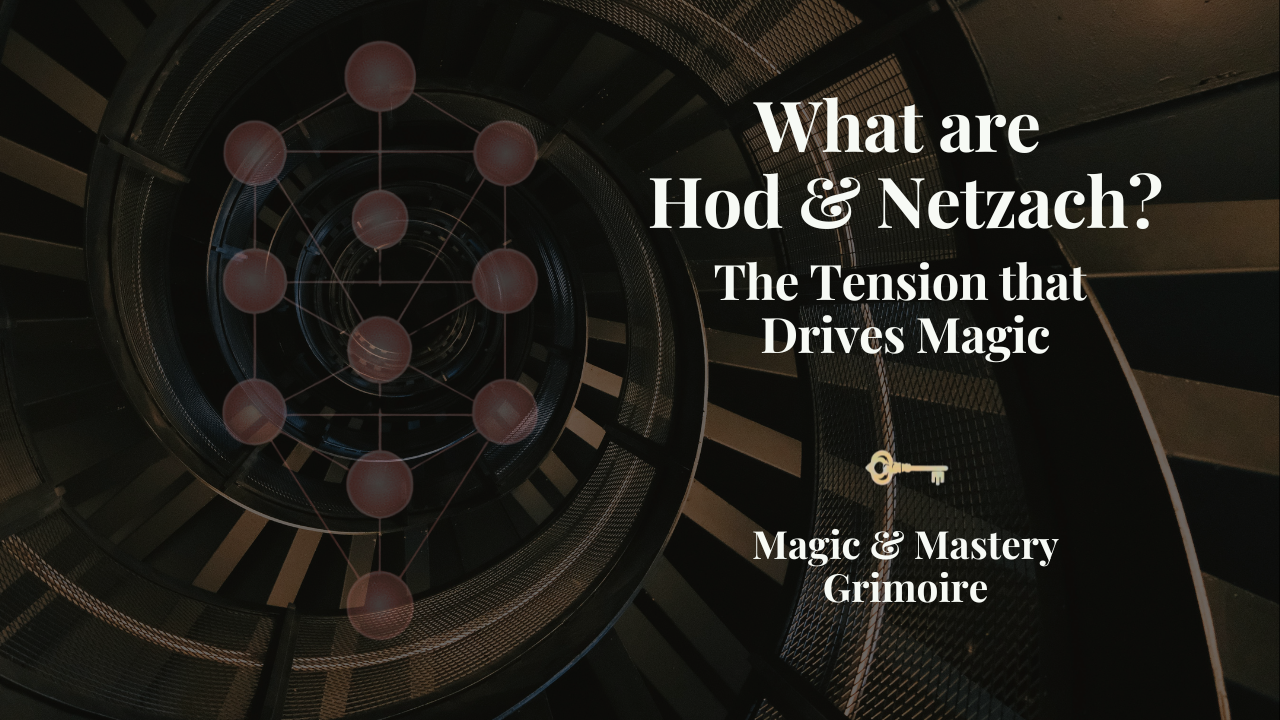
Many magical problems are actually arguments.
Not arguments between you and the universe, or between your practice and your circumstances — though those are very real, too.
No, I mean the argument between what you feel and what you think. Between the emotion that has no edges and the story that tries to give it some. Or simply between what you want on some level, and what you think you should want, or believe you are allowed to have.
In other words, it’s the argument between Netzach and Hod.
These two Sephiroth are part of the tension engine of the lower Tree. Understanding what they are — and what happens when they're in conflict — explains more about why magic works, and why it doesn't, than almost anything else on the map.
Netzach, the Seventh Sephirah
Netzach sits at the base of the right pillar — the Pillar of Force — directly below Chesed and across the Tree from Hod. Its name means Victory. Its planet is Venus. Its element is fire. Its color is green, flecked with gold, the color of living things.
It is the sphere of pre-verbal feeling. Not emotion as a concept you've organized into language, but the raw thing that precedes language entirely — the gut response, the magnetic pull, the aversion that hits before the mind has had a chance to weigh in. Desire before it has a name. Love as a felt experience rather than an idea. The life force moving through the body the way it moves through the green world: not according to a plan, but according to its own deep logic.
Netzach governs all the creative arts — not because creativity is decorative, but because making something requires tapping directly into this pre-verbal current. The artist's muse is Netzach. The experience of genuine awe — that sense of something vast and difficult to comprehend, the feeling Einstein called the source of all true art and science — is Netzach. The energy of the natural world, the felt resonance of a stone in your hand that tells you before thought does whether it belongs in this working or not — all of it Netzach.
The spiritual experience of this Sephirah is the vision of love triumphant, or the vision of beauty triumphant. Which sounds like something you'd embroider on a pillow, until you've actually had the experience. It's not prettiness. It's the sudden overwhelming sense that beauty is real and that you are inside it — what psychologists now study under the name of awe, and what the tradition recognized centuries before psychology had a word for it.
The vices of Netzach are lust and impurity — meaning not sexual licentiousness specifically, but the broader problem of craving: the addiction to feeling itself, the inability to release what you're attached to, the way desire can calcify into obsession and pull you entirely outside yourself. The virtues are love and harmony — not as sentimental concepts, but as the genuine expression of the life force moving cleanly through desire without getting stuck in it. The difference between Netzach's virtue and its vices is precisely the difference between feeling that flows and feeling that grips.
Hod, the Eighth Sephirah
Hod sits at the base of the left pillar — the Pillar of Form — directly below Geburah and across the Tree from Netzach. Its name means Splendor, or Glory. Its planet is Mercury. Its element is water. Its color is orange.
It is the concrete rationalizing mind. Every word you use to describe an experience. Every framework, system, and category you've ever found useful. Every magical correspondence — the planet-to-metal-to-herb-to-color chain that runs through ceremonial magic, all of it organized and filed by Hod. All languages. All theologies. All sciences. If you can study it with your analytical mind, it lives in Hod.
Eliphas Lévi called the magical books of Mercury the Books of Thoth — Thoth being the Egyptian god of writing, wisdom, and magic, the direct precursor to the Hermetic Mercury. It's not a coincidence that the god of magic is also the god of language. Language is how Netzach's raw energy gets given form, direction, and a specific address in reality. Words of power aren't just words. They're Hod harnessing Netzach — the organizing principle of the analytical mind channeling the felt power of the instinctive body into something that can actually do something in the world.
The virtue of Hod is truthfulness. Its vice is the bending of truth — falsehood, deception, rationalization. And this is where it gets interesting, because the most insidious lies Hod tells are the ones you tell yourself. Mercury is the god of trickery as well as wisdom, and Hod is just as capable of elaborate self-justification as it is of clear analysis. The rationalizing mind is very good at building worlds that confirm what the ego already believes. That's not analysis. That's Hod working against you.
The Tension Between Hod & Netzach
Netzach and Hod sit at the base of the outer two pillars, facing each other across the Tree. Their relationship is not cooperative by default. It is productive friction — the creative tension between force and form, feeling and structure, the fluid and the bounded.
Here's the basic dynamic. Netzach generates enormous energy but no specific form. It is all the passion in the world, all the desire and life force and instinctive drive, with no edges and no direction. Left to itself, it would pour outward forever, generating experience without ever manifesting anything specific. But infinite possibilities are not the same thing as a result.
Hod provides the structure. The intention. The words that give the feeling an address. The precision that allows the energy to go somewhere rather than everywhere. The sacrifice Hod makes is exactly the one that makes magic possible: in order to manifest anything specific, you have to cut off the other possibilities. An intention that says this is what I'm working toward is simultaneously an intention that says not that, or that, or that other thing over there. Practitioners who resist crafting precise intentions are resisting Hod — and therefore resisting manifestation. The infinite fluidity of Netzach is the fuel. The limiting structure of Hod is what directs it.
But Hod without Netzach is equally useless. A perfectly constructed magical working with no genuine emotional charge behind it is an empty form. The sigil is drawn. The correspondences are correct. The timing is right. And nothing moves, because there is no felt energy animating the structure. The Qabala puts it precisely: in Hod, the power of Netzach is hidden inside the forms. When it isn't — when the form is there and the feeling isn't — you have the magical equivalent of a beautifully wired electrical circuit with no current flowing through it.
If you're spending a lot of time in your practice, and you're mostly doing the Hod work — the reading, the correspondence-studying, the carefully constructed ritual frameworks — and you're not connecting to the felt, embodied, instinctive charge that makes all of that structure live, you have a Netzach deficit. The circuit is beautifully laid out and completely dark.
Conversely, if you're all Netzach — all feeling, all passionate connection to the work, all instinctive response — and you're not bringing Hod's precision to bear, the energy is real but it's diffuse. You're working hard and feeling a great deal and manifesting nothing in particular, or manifesting randomly. The energy is real. It just has no address.
Why Creative Tension Matters for Practice
The diagnostic question is simple. When a spell isn't landing, or when a pattern keeps repeating despite genuine effort, look at this axis first.
Is there real emotional charge behind the work? Is there something you actually want, actually feel, actually care about — or is the practice operating from structure alone, going through the motions of a well-constructed ritual? That's a Netzach question.
Is the intention specific enough for Hod to work with? Does the ritual have language — a precise statement of what you're actually trying to create, in what form, by what means? Or is it aimed at something so general that Hod has nothing to build a structure around? A spell aimed at abundance and flow is asking Mercury to organize something Mercury can't get its hands on. What form? Where? When?
The tension between these two Sephiroth is not a problem to be solved. It is the creative engine of the lower Tree. Yesod, directly above the point where they converge, is what forms when Netzach and Hod are both contributing: the reality bubble crystallizing from the union of instinctive charge and organized intention. When both are working, the bubble is coherent. When one dominates or the other is absent, the bubble forms anyway — just not the one you were trying to build.
That's why most magical work that fails isn't failing at the level of technique. It's failing at the level of this argument — the one between what you feel and what you think, between the fluid and the formed.
Here’s the real secret: Qabala doesn't ask you to resolve the argument in favor of one side or the other. It asks you to embrace both as true and essential, and let the tension between them produce something neither could produce alone.