What Is Kether? The Limits of the Rational Mind
Apr 16, 2026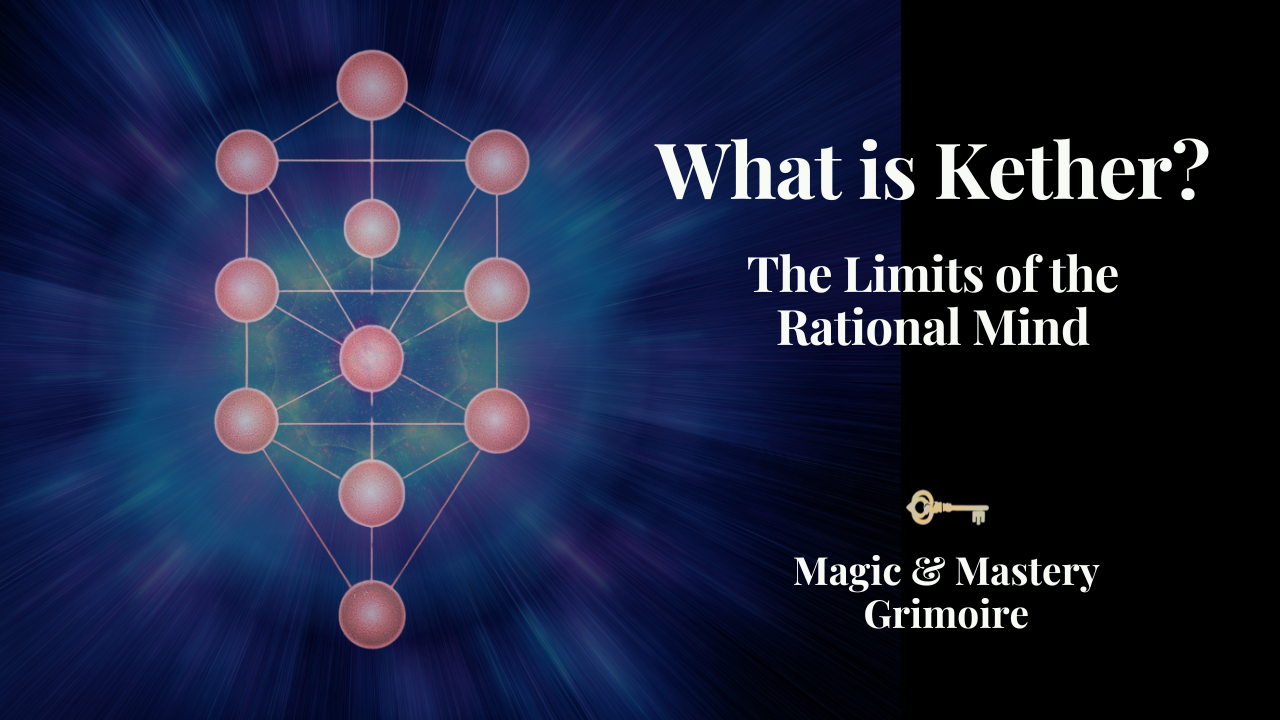
Everything the rational mind does well — naming, categorizing, analyzing, comparing, building structures of meaning — becomes a liability when you try to think your way toward Kether. Not because Kether is opposed to intelligence. Because Kether is the level at which the distinction between thinker and thought dissolves, and the mind that generated the distinction cannot follow you past its own disappearance.
This is the honest problem with writing about the first Sephirah. Whatever can be said about Kether is not Kether. The map, which has been useful all the way up the Tree, reaches here and stops working in the usual way. What remains is pointing.
With that caveat clearly in place: here is the pointing.
Kether, The First Sephirah
Kether is the first emanation on the Tree of Life, located at the top of the middle pillar — the crown of the entire structure. Its name means the Crown. Its color is brilliant white, the white that contains all colors the way a prism contains the spectrum before the light hits it. It has no planetary association in the classical system; modern astrologers have sometimes assigned it Neptune, at the outer edge of the visible solar system, as far as you can get before you leave the solar system entirely. Its number is one.
The nicknames accumulate into a kind of negative theology — a description built from what Kether is not, or what it barely is, because positive description fails:
The Hidden Intelligence. The Fountain of Creation. The First Whirling. The Great Cosmic Egg. The Breath of That Which Is Not. The Source of Energy from the Infinite Unmanifest. The Point.
Each one of these gets at something. None of them gets all the way there. The tradition knows this. It is part of the teaching.
Its virtue is the completion of the Great Work — the attainment of union with the divine. It has no vices. This is not an oversight. There is no self at Kether to generate imbalance. Vice requires a “there” to be out of step with, a self that has gone wrong. In Kether there is no self left to go wrong.
What Kether Actually Is
Kether is the point at which the cosmos re-coalesces into oneness. Working up the Tree from Malkuth, each Sephirah represents consciousness becoming less dense, more unified, closer to source. By Chesed you have left the personal behind. By the Supernal Triangle you have left individuality behind. Kether is the end of that sequence — the place where all the multiplicity that began with the first polarity of Chokmah and Binah, all the emanations that cascaded down through nine subsequent Sephiroth, returns to the undifferentiated unity from which it came.
Not a God in the theological sense — not a person, not a will, not a consciousness that makes decisions. A state of being without any activity whatsoever. Pure existence in potential. Mystics who have approached it consistently describe the same thing: a blinding white light in which all thought, all sense of self goes completely blank. Blank is not even the right word, because blank implies an absence that could be otherwise filled. Kether is prior to the categories in which absence and presence make sense.
To enter Kether, you must be willing to give up yourself and not return. Which is why most of us, most of the time, are working with its edges rather than its interior.
The Three Veils
Behind Kether — above it, in the topology of the Tree, though above and behind are metaphors — the tradition describes three veils of negative existence: Ain (nothing), Ain Soph (limitless nothing), and Ain Soph Aur (limitless light). These are not Sephiroth. They are not even things that can be named without the naming immediately becoming misleading. They are the tradition's attempt to point at whatever is behind the first emanation — the ground from which even Kether emerges.
Kether is already the most concrete thing in the Supernal Triangle, in the same way that the number one is already the most concrete thing in the sequence that precedes counting. Before one, there is not zero — zero is still a number. There is the absence of the concept of number entirely. The veils are that absence. Kether is the first moment the absence becomes a presence.
The ancient bearded king seen in profile — one of the Jewish Kabbalah’s images for Kether — is shown with his right side visible and his left side hidden in the mystery. Half revealed, half concealed. One face looking toward creation, one face still in the darkness behind all creation. That image gets at something the conceptual description cannot quite reach: Kether as threshold, as the face that creation wears when it has almost returned to being nothing.
The Hidden Intelligence
Kether's most practically significant nickname is the Hidden Intelligence.
Hidden, because Kether is the intelligence that operates in everything below it — the divine spark that exists, latent, in every Sephirah, in every stone and star and strand of DNA — while remaining invisible to ordinary consciousness. You cannot see it from here because you are it. The fish does not perceive the ocean. The eye cannot see itself see.
This is not mystical vagueness. It is a structural claim about the relationship between consciousness and its source. The light that flows from Kether through every path and Sephirah down to Malkuth is the current through the circuit. All of it is the same light at different levels of density. Kether is the current at its most undifferentiated, before the circuit begins.
A practitioner who tries to do magic by pulling energy from some source other than this primary current — who constructs a working without grounding it in that original impulse, whatever they call it — is paddling upstream, working against natural law. The reason the Hermetic tradition invokes the Tree of Life in its ritual structure is precisely this: because the Tree defines the pattern that everything exists within, and working with that pattern rather than against it is what makes magic coherent rather than lucky.
The Limits of the Rational Mind
Here is where the post's title arrives.
Every Sephirah below Kether — even Chokmah and Binah, even the abstract territories above the Abyss — can be approached through the rational mind as a starting point, even if it cannot be fully comprehended that way. You can construct an intellectual framework for Chesed. You can analyze the tension between Netzach and Hod. You can diagram the emanation process from Kether to Malkuth and identify where you are on the map. The rational mind is a powerful and essential tool for working the Tree.
Kether is the place where that tool is not so much set aside as rendered structurally irrelevant. Not because reason is bad — Hod is a Sephirah, language and analysis have their place, the whole architecture of the Tree is a product of extraordinary rational rigor. But because reason operates through distinction — this rather than that, subject rather than object, thinker rather than thought — and Kether is prior to distinction. You cannot think your way to the place before thinking began.
This is the specific thing the rational mind cannot do: it cannot get outside itself. It can describe the limit. It cannot cross it. The crossing, when it comes, happens through a different faculty — through the accumulated development of everything below it on the Tree, through contemplation and pathworking and years of genuine integration, through something that eventually breaks through the ceiling the analytical mind mistakes for the sky.
What the rational mind can do — usefully, honestly, without pretension — is recognize the limit and stop pretending it isn't there. This is the beginning of the work that leads to Kether.
Where This Leaves the Practitioner
Kether is the reason the Great Work has a name that implies it is never quite finished.
The full circuit of the Tree runs from Kether down through all ten Sephiroth to Malkuth and back — the lightning bolt descending and the return path ascending, over and over, in the life of a practitioner who is doing the work over time. Each pass up the Tree integrates something that the last pass couldn't reach. The Tree keeps revealing new things the longer you work with it. The student who takes a course twice gets something different the second time — not because the material changed, but because the practitioner changed.
Kether is the orientation point for that entire journey. Not a destination you arrive at and tick off the list. A direction: the direction of more unified, more clear, more connected, more conscious. Every move up the Tree is a move in that direction. Every stuck pattern worked through, every level integrated, every Sephirah experienced from the inside rather than the outside is that direction being followed.
The tradition puts it simply: the virtue of Kether is the completion of the Great Work. Completion, in this context, is not a moment that arrives. It is a process. It is what you are working toward every time you pick up the map and start climbing.
That is what the crown at the top of the Tree is for. Not to be grasped. To be oriented toward.