What Is Malkuth? The Sephirah Where Magic Manifests
Apr 13, 2026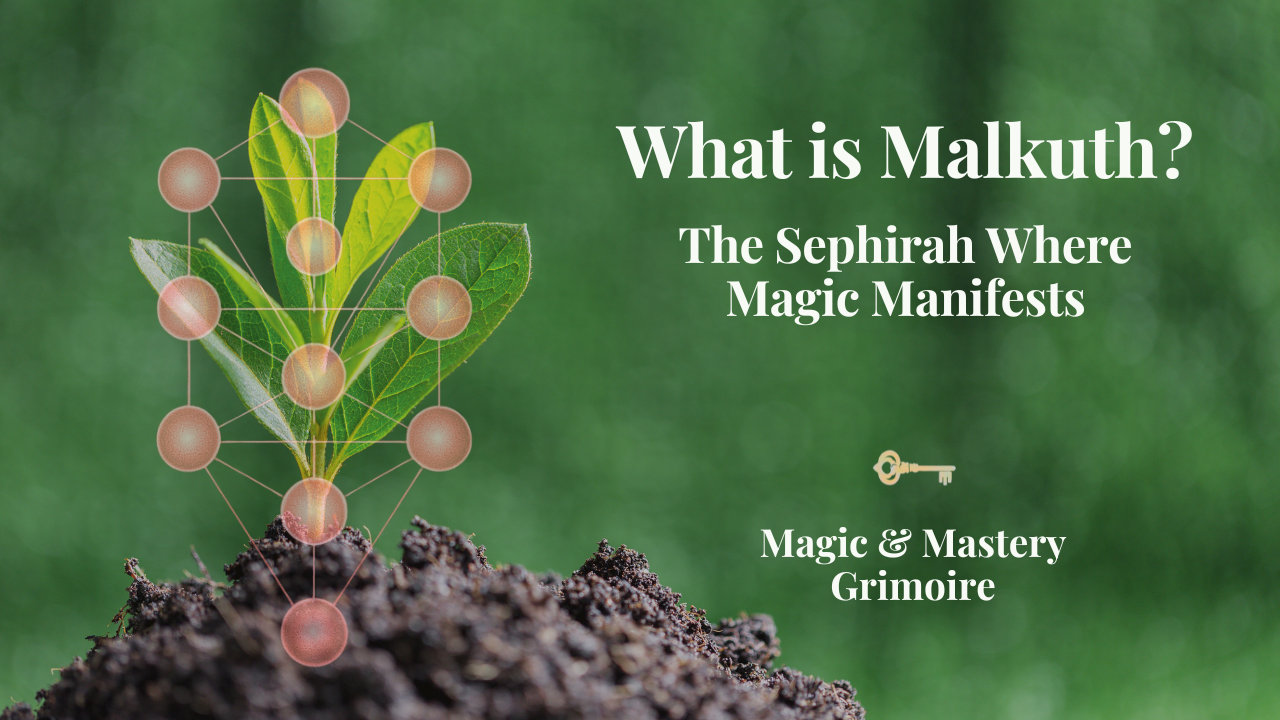
There's a particular kind of magical practitioner who has done a great deal of inner work and has very little to show for it in the physical world. They've processed their shadow. They've set intentions under the right moon. They've read the cards, worked the transits and built the altar. The inner landscape is richly developed. And yet the outer circumstances remain stubbornly, confusingly unchanged.
If this sounds familiar, the Tree of Life has a diagnosis. The working never landed in Malkuth.
Malkuth is not the least interesting part of the Tree. It is the part that decides whether anything actually happens.
Malkuth, the 10th Sephirah
First, the basics. Malkuth is the tenth and final Sephirah on the Tree of Life — the bottom of the central column, the base of the entire structure. Its name means Kingdom. Its element is earth. Its astrological body is Earth itself, the ground under your feet. Its symbol is the cross in a circle, representing the four elements held within the sphere of manifestation.
In other words, Malkuth is the physical world. The body. The material circumstances of ordinary life. Every atom of the observable universe, from the rocks in your garden to the stars in the sky. The realm of kickable objects, so to speak, the only world where you can pick something up and drop it again.
In the structure of the Four Worlds, Malkuth stands alone as the sole Sephirah of Assiah, the material world. Everything above it on the Tree — Yesod, Hod, Netzach, Tiphareth, all the way up to Kether — belongs to more subtle levels of reality. Malkuth is where all of that subtlety finally condenses into something you can touch.
Why It's at the Bottom
A common misreading of the Tree treats Malkuth as the least important Sephirah — the lowest, the most mundane, and therefore the least interesting. This gets it exactly backward.
Malkuth is where everything must arrive. Every magical working that doesn't reach Malkuth hasn't finished its journey. Every spiritual insight that doesn't eventually change something in the physical world has completed half a circuit, at best. The light doesn't turn on if the current doesn't reach the filament.
The tradition is emphatic on this point: you cannot climb a tree from the top. Malkuth is where you begin, and it's where every working must end. Not because the physical is more real than the spiritual — the Hermetic tradition is the last tradition to make that argument — but because the complete circuit runs from Kether all the way down to Malkuth and back. Miss the bottom, and you've broken the loop.
This is also why grounding is not optional prep work before real magic. It's the activation of Malkuth, the switch that opens the circuit. Before the journey and after it, you orient yourself to earth, because that's where experience integrates. Not in Yesod, not in Hod — in Malkuth. The body is where things become real.
The Gateway
The Hermetic tradition gives Malkuth several names, and a striking number of them are about thresholds. The gate of birth. The gate of death. The gate of tears.
Gate imagery points to the same structural fact from multiple angles: Malkuth is the boundary between the physical and all the rest. Birth is the soul's crossing into Malkuth. Death is the crossing back out. From the soul world, every physical birth is a death; every physical death is a birth. The gate swings both directions. The label depends entirely on which side you're standing on.
This is why Malkuth is also called the place of completion. You must learn the lessons of this Sephirah in order to progress spiritually — not despite the fact that it's physical, but because of it. The material world has a quality that nothing above it on the Tree has: endurance. Malkuth doesn't shift when you're not paying attention. It holds. And that stability is what gives the integration work somewhere to land.
Insights that never reach the body dissolve. Intentions that never anchor in physical action remain in Yetzirah, reshaping themselves into beautiful astral constructs that produce no observable results. Malkuth is stubborn, dense, and slow — and those are not criticisms. They're descriptions of what makes it valuable.
The Vices and the Virtue
Malkuth's vices are inertia and materialism.
Inertia is the refusal to change — the ego digging in, the physical patterns persisting because disrupting them is genuinely hard and the body is very, very good at maintaining its current state. Consciousness can evolve dramatically at the Yetzirah level while Malkuth quietly holds the old structure in place. This is why sustained magical practice eventually requires that something actually change in the material world, not just in the imagination.
Materialism is the other ditch. It's not wrong to work with physical reality; Malkuth is where magic manifests, and the physical is sacred in the Hermetic framework. The vice is when the physical becomes the only level of attention — collecting the perfect tools, taking all the courses, building the beautiful altar — as a replacement for doing the integration work rather than as a support for it. Malkuth without the rest of the Tree is just accumulation.
Malkuth’s virtue is discernment. The ability to see clearly what is actually present in the physical world, without inflation and without denial. Discernment at the Malkuth level is what allows a practitioner to assess honestly: what has this working actually produced? What is materially different? What changed, and what didn't? That assessment is not a failure of faith. It's the feedback that makes the next working more precise.
The Spiritual Experience of Malkuth
Here's what surprises people when they first encounter it: the spiritual experience associated with Malkuth is a vision of the Holy Guardian Angel.
Not union with the divine — that's Kether. Not the vision of harmony — that's Tiphareth. The experience at the base of the Tree, at the most material level, is the first glimpse of the Higher Self: a luminous figure appearing as something distinct, something calling you toward greater depth, something you are not yet but might become.
The tradition is making an argument here. The first encounter with the divine isn't at the top of the Tree. It's at the bottom, in the body, in the ordinary physical world, in the moment when a person first recognizes that they are more than their material circumstances. That recognition is Malkuth doing its work. It is, in the language of qabala, resplendent intelligence; that’s splendor shining through the densest level of manifestation.
The spiritual path doesn't begin when you leave the physical world behind. It begins when you start paying real attention to it.
How to Work with Malkuth
When your working isn't landing, Malkuth is always the first question. Not the only question — but the first one. Is there a physical foothold for this intention? Has anything in the material world actually changed, or is the work suspended in Yetzirah, hovering beautifully above the ground?
Magic doesn't float. It has to be rooted in the real.
So, for example, a prosperity spell cast from a space that materially signals scarcity — unpaid bills on the desk, a body running on cortisol, a physical environment that contradicts the intention at every turn — is fighting Malkuth's inertia with one hand tied behind its back.
The fix is not more spiritual effort. It's one concrete physical act that gives the working somewhere to stand. Clear the space. Take care of the nagging business. Change one thing that your body encounters every day.
The same diagnostic applies to any stuck pattern. If the inner work is genuinely happening — if you can see the shift in your emotional field, in your thought patterns, in your Yesod-level sense of reality — and the physical circumstances still refuse to move, Malkuth is where to look. Something in the material container is holding the old shape. You’ll have to roll up your sleeves and make some changes there – not everything, but enough to get things moving.