What Is Tiphareth? The Heart of the Tree of Life
Apr 14, 2026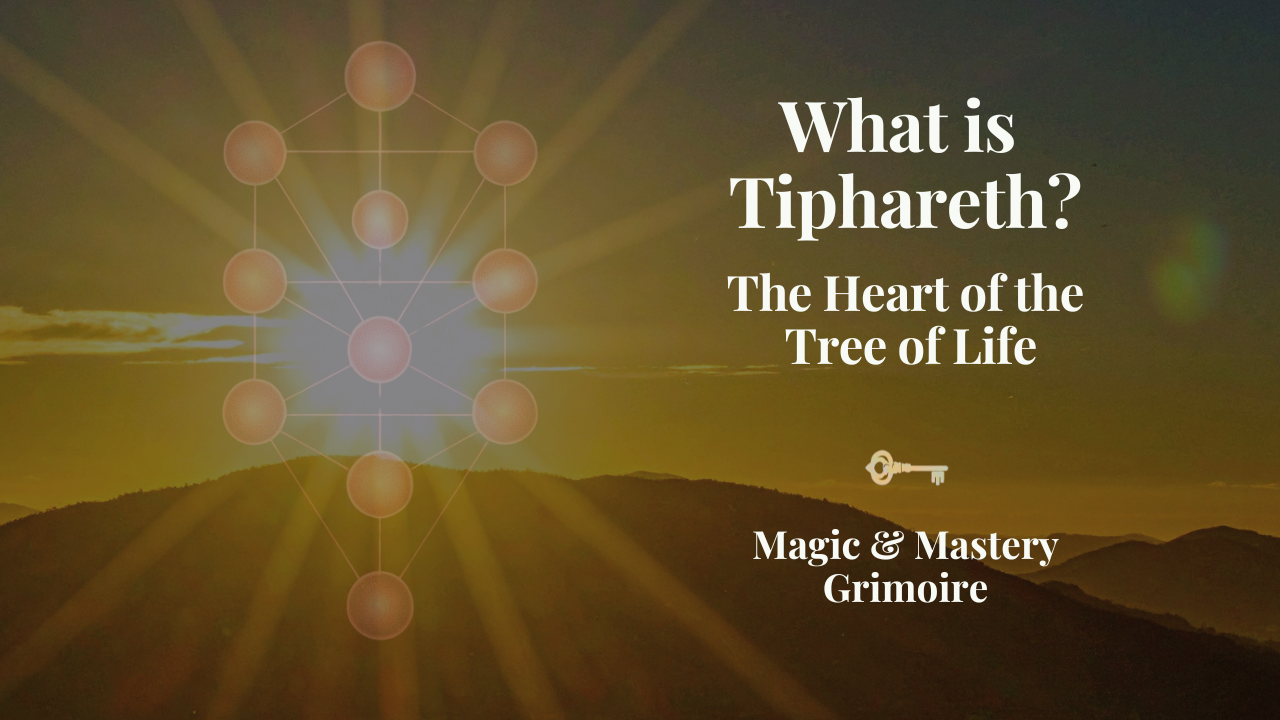
There's a moment in serious magical practice when something shifts in how you understand yourself. Not a new belief, not a reframe, not an insight that you could have produced by thinking harder. Not everyone reaches it, and nobody can force it.
Something more like a recognition. A sense of being looked at from within, by something that has always been there and was simply waiting for you to stop talking long enough to notice it.
That's Tiphareth. Or more precisely: that's Tiphareth beginning to make itself known.
Tiphareth, the Sixth Sephirah
Tiphareth is the sixth Sephirah on the Tree of Life, located at the center of the middle pillar, the heart of the structure. Its name means Beauty, but not beauty in the decorative sense. The ancient meaning of beauty is the harmony that emerges when all parts are in proper relationship with one another. The Greeks called this the golden ratio; mathematicians call it Phi. Tiphareth is the point on the Tree where everything is in proper relationship, because it is connected to more Sephiroth than any other node on the map.
Count them: Tiphareth has direct paths to Kether, Binah, Chokmah, Chesed, Geburah, Netzach, Hod, Yesod and Malkuth. It is the crossroads of the entire Tree. It’s also the balancing point of the ethical triangle, where the expansive mercy of Chesed and the disciplining severity of Geburah find their dynamic equilibrium. The crown of the lower Tree and the heart of the middle one. The Sun is its planetary correspondence: the center around which everything else orbits.
Its symbol is the hexagram — two interlocking triangles, the upward-pointing triangle of aspiration meeting the downward-pointing triangle of manifestation. As above, so below. The place where those two movements meet.
What Higher Self Actually Means
Tiphareth is identified in the tradition as the seat of the Higher Self, a phrase so thoroughly diluted by generic spiritual language that it has nearly lost its meaning. It's worth recovering the specific thing the Qabala is pointing to.
The persona — the personality, the ego, the self you negotiate the world with every day — is constructed from the lower Tree. It's assembled from the inputs of Malkuth, the emotional charge of Netzach, the interpretive framework of Hod, crystallized into the reality bubble at Yesod. That persona is real. It is not fake or bad or something to be eliminated. But it is a construct. It is the mask, as the tradition puts it, that covers the Higher Self.
The Higher Self at Tiphareth is something else. It is the divine spark within each person — the level of consciousness at which you are not just the product of your history, your conditioning, your accumulated Yesod-level sense of who you are. It is the part of you that your Tarot cards are trying to reach when a reading goes genuinely deep. It is the light behind the persona, the stable center above the churning of the lower Tree.
And critically, it is the highest level at which an individual's sense of self still exists. Above Tiphareth, on the other side of the Abyss, lies the Supernal Triangle — Kether, Chokmah, Binah — where individual identity dissolves into something larger. Tiphareth is the summit of personal selfhood, the place where the individual is most fully themselves because they are most fully connected to their source. Above that, there is no self left to connect.
The Realm of the Sacrificed Gods
One of Tiphareth's oldest epithets is the realm of the sacrificed gods. This is the Sephirah associated with Osiris, with Christ, with every solar deity in the Western tradition who dies and is reborn. The mythology is consistent across traditions because it points to the same underlying fact: the ego must be willing to surrender for the Higher Self to become accessible.
This is the vision of the mystery of sacrifice. It’s one of the two spiritual experiences associated with Tiphareth, alongside the vision of harmony. Not sacrifice in the sense of deprivation or self-punishment, but in the original sense of the word: to make sacred, to offer up, to transform something into something of greater value. What the ego offers up at Tiphareth is its insistence on being the whole story. What it receives in return is the larger perspective that has always been there, waiting.
This is also why Tiphareth is sometimes called the mediating intelligence or the sanctifying intelligence. It mediates between the divine above and the human personality below. It sanctifies — makes sacred — the ordinary experience of being a person, by showing that physical experiences are always already grounded in something divine.
The Veil of the Parochet
Between Tiphareth and the lower Tree sits a boundary Hermetic Qabala calls the Parochet, the veil. The word comes from the temple veil in the Jerusalem Temple that separated the outer sanctum from the inner sanctum, the Holy of Holies.
In Hermetic Qabala, the Parochet marks the threshold between the Tree's personality triad and the Higher Self. Below the veil, everything is familiar: the territory of daily experience, of emotional charge, of analytical mind and of the assembled reality bubble. Above it, experience becomes different in kind, not just in degree. More symbolic. Less easily analyzed. The kind of thing you can approach through pathworking and meditation, but that resists being pinned down by the ordinary thinking mind.
The paths that cross the Parochet are the paths of the ego learning to release its grip on its own limited version of reality. In the Hermetic Qabala, each of the 22 paths on the Tree corresponds to one of the Tarot’s Major Arcana. The Tower trump sits directly at the threshold of the Parochet. In this light, it’s not just a symbol of disruption; it is specifically the disruption required to cross the veil. In other words, the moment when the persona's carefully constructed model of who it is and how things work gets struck by the Tree’s lightning path, and what falls away to make room for what was always above it.
Why Tiphareth Changes Everything
Here is the practical argument for why Tiphareth matters.
Most magical practice operates from the personality level — from the assembled construct of Yesod, animated by Netzach and structured by Hod, grounded in Malkuth. This is not wrong. The lower Tree is where most of the work happens, and it is rich territory. But it has a ceiling. Working from the personality means working from the level at which conditioning, habit and the accumulated Yesod-level image of what is possible are all in play. The patterns of the lower Tree limit what can be achieved from within the lower Tree.
Working from Tiphareth — or more accurately, learning to orient toward Tiphareth as the operative center of consciousness — changes the axis from which everything else operates. The same tools, the same practices, the same Tarot reading or astrological transit, look completely different from the Higher Self's perspective than from the persona's. Not because the external facts have changed, but because the level from which they're being apprehended has shifted.
This is what the tradition means by the knowledge and conversation of the Holy Guardian Angel — the central aim of serious Hermetic practice, the long project of establishing genuine communication between the persona at the bottom of the Tree and the Higher Self at its center. Not a mystical event that happens once and transforms everything overnight. A deliberate, sustained practice of orienting, of turning the instrument of consciousness toward the frequency of Tiphareth and learning to hold that frequency long enough for it to become recognizable.
The virtue of Tiphareth is commitment: dedication to the Great Work. Its vices are false pride and egocentrism: the persona claiming Tiphareth's insights as its own achievements, the ego using the language of Higher Self while remaining fully in charge. The tradition has seen this failure mode many times. It has a name for it: spiritual ego. The very apparatus that Tiphareth is asking to step back attempts to colonize the experience of stepping back.
Which is why the work is not one conversation. It is the ongoing practice of returning, again and again, to the center of the Tree: the crossroads where all paths meet, the Sun at the heart of the system, the place where you are most fully yourself because you are most fully connected to what you came from.