What is Yesod? The Astral Light & Your Reality Engine
Apr 13, 2026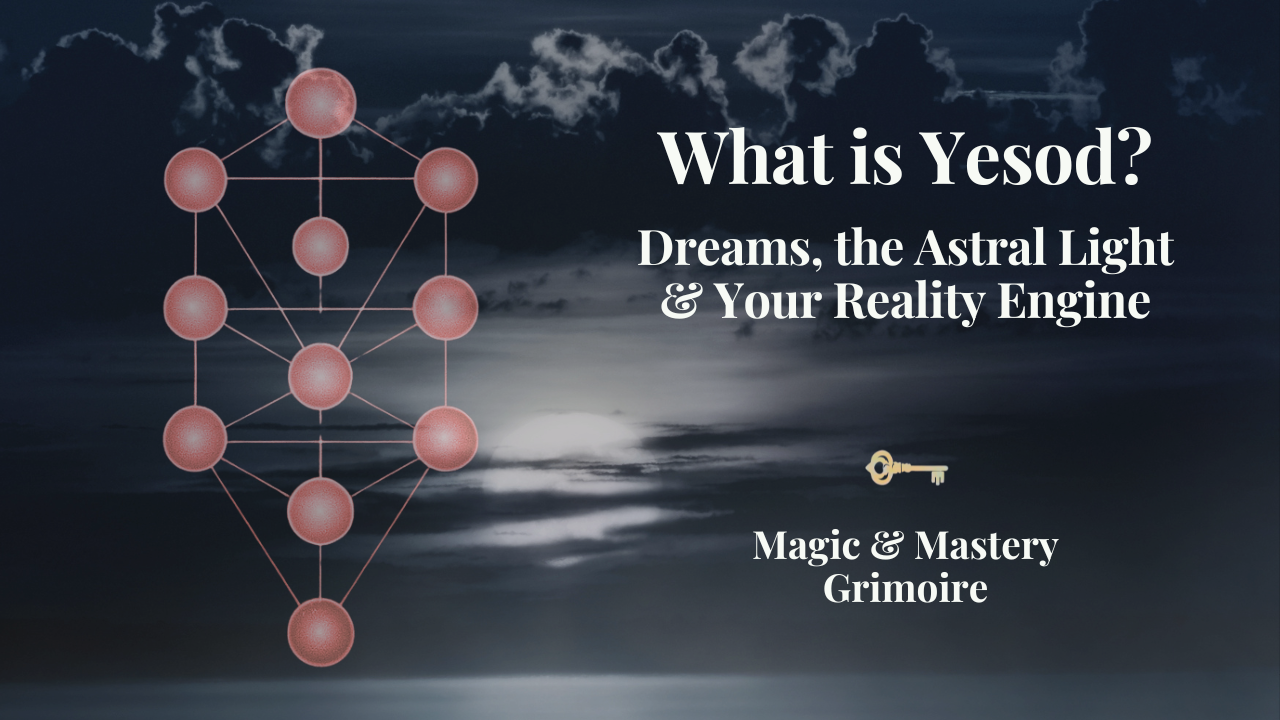
So, you've done the spell correctly. You've set the intention, worked the timing, built the altar, spoken the words. You can feel it when you're in it — something real is moving. And then you wait. And the situation doesn't change. Or it changes briefly and then reconstitutes itself in the old shape, like a room you've cleaned that somehow returns to its previous state of disorder without anyone doing anything obvious to it.
The working reached Yesod. It just didn't stick.
Yesod, the Ninth Sephirah
Let’s start with the basics. Yesod is the ninth Sephirah on the Tree of Life, sitting at the base of the middle pillar, directly above Malkuth and directly below Tiphareth. Its name means Foundation. Its planet is the Moon. Its element is the astral light — that’s what Hermeticists call the vitalizing field behind all physical manifestation, the medium in which images form and through which magical workings travel on their way to becoming real.
Yesod is the astral body. The dream-space. The imagination in its deepest sense — not daydreaming or wishful thinking, but the generative field in which your experience of reality takes shape before it arrives in physical form.
Here is what Yesod actually does: it collects everything coming in from Malkuth (what you're physically taking in), Netzach (your emotional charge and instinctive response), and Hod (the story and meaning you're assigning) — and crystallizes all of it into your felt sense of what is real. Your reality bubble assembles itself here, constantly, in real time, from those three inputs.
That bubble is not reality. It is your model of reality. And it is running whether you're paying attention to it or not.
The Mind Field
Hermetic Qabala describes Yesod as astral light — a field that metaphysicians experience as a kind of generalized tingling, a sense of presence that most people ignore the way fish ignore water. It is the matrix in which consciousness moves. Parapsychologists, working from a completely different direction, describe the same thing: a multi-layered mind field being manipulated in activities like remote viewing, telepathy and dream states.
Occultists worked with this field long before parapsychology gave it a name. The work of esoteric orders like the Golden Dawn is, at significant depth, the work of learning to perceive, enter and deliberately operate in Yesod — to concentrate the astral light intentionally rather than letting it assemble itself on autopilot.
Because it does assemble itself on autopilot. That's the point most practitioners miss. You are building your reality bubble every moment of every day, largely unconsciously, from whatever inputs happen to be flowing through Malkuth, Netzach and Hod at the time. Magic is what happens when you start doing that deliberately.
The Moon and Yesod
Yesod's association with the Moon is not decorative. It's structural.
The Moon is the most rapidly cycling of the traditional planets — waxing and waning on a 29-day cycle, the visible representative of the tides and rhythms of the astral field. Yesod is undulating change. It goes through cycles. When the Moon is increasing in light, the available astral light is increasing with it — more energy present in the mind field, more responsiveness in the medium through which workings travel. When the Moon is waning, that energy is withdrawing.
This is why magical traditions across centuries have said to work with the waxing Moon. Not superstition. A structural observation about the cycling of the very field that magical workings must pass through. The timing advice you already use is Yesod-awareness built into folk practice.
The Dream Connection
Dreams are what Yesod does when the inputs from Malkuth go quiet.
With no external physical stimulus to process, the mind keeps generating images — stories, encounters, landscapes that feel entirely real while you're in them. The brain waves of dreaming and certain states of waking consciousness are the same. What the mystics of every tradition have learned to do is access that image-generating capacity while awake — to enter the dream-space deliberately, with intention, rather than only passively while unconscious.
This is the basis of visualization practice, of pathworking, of deep meditation that produces genuine visions rather than just mental quiet. The skill is real and learnable. It starts with small things: hold an object, study it, close your eyes and reconstruct it in as much detail as possible. The mind can create a full-body experience of anything without direct sensory input. That is not metaphor. That is the actual capacity being trained.
The Spiritual Experience of Yesod
The spiritual experience of Yesod is described as the machinery of the universe — a sense of apprehending the underlying mechanism by which thoughts and feelings create experience. The law of attraction, as practitioners sometimes call it, though that phrase undersells the precision of what Yesod actually is. It isn't the sense that positive thinking produces positive results. It is the direct perception of the assembly process itself: watching your experience form in real time from its component inputs.
The Labyrinth Problem
Here's the thing about Yesod that the tradition is careful to flag: it is extraordinarily impressionable, and it is yours.
Yesod is reflected light — a stepped-down version of divine light, made digestible, made workable. The price of that accessibility is susceptibility. Because Yesod forms images from whatever is fed into it, and because the unconscious is one of the things feeding into it, what you see in the astral is not a neutral record of what's there. It is what you expect, what you fear, what you've been conditioned to perceive — projected outward with full sensory conviction.
And so Yesod can become a labyrinth of infinite images in which practitioners get lost — captivated by the noise being reflected back, mistaking the elaborate productions of their own unconscious for external reality. It is inherently neutral. It is not a negative place. But it amplifies whatever you bring into it, including the parts of yourself you haven't met yet.
This is also, incidentally, why charismatic leaders can move masses of people. Sufficient will and focus applied to Yesod at scale is propaganda, collective dream-spinning, the manufacturing of shared realities. The same force that makes a well-constructed magical working effective also makes a well-constructed narrative about enemies and threats effective. The field doesn't evaluate content. It transmits and amplifies.
The Vices and the Virtue of Yesod
Yesod's vices are idleness and envy — and they illuminate each other when you put them together.
Idleness here doesn't mean laziness in the ordinary sense. It means the failure to do the inner work that Yesod requires: the active, deliberate engagement with the imagination, the sustained practice of visualization and pathworking and dream attention that keeps the astral field from running entirely on autopilot. Yesod is always active — the reality bubble assembles itself whether you're paying attention or not. Idleness at this level means letting it assemble from whatever happens to be lying around: unexamined conditioning, ambient cultural input, the oldest and loudest emotional patterns you've never quite taken apart. The bubble forms. You just didn't build it.
Envy is the vice that emerges when the reality bubble is organized around comparison rather than genuine desire. Envy is Yesod looking sideways — assembling a felt sense of reality based not on what you actually want but on what someone else has that you don't. It is the corruption of Yesod's legitimate function: instead of the imagination being used to crystallize genuine intention into form, it is used to generate elaborate felt experiences of lack, of being on the wrong side of a comparison, of a world organized around other people's better luck. Envy turns the astral field into a mirror pointed at everyone else. Nothing of yours grows in that field.
The virtue is independence — or more precisely, self-governance. Not isolation, but the capacity to run your own inner life rather than having it run by whatever input happens to be loudest. At the Yesod level, self-governance means conscious authorship of the reality bubble: knowing what you're putting into it, why, and from what level of yourself the direction is coming. It is the difference between a practitioner who responds to the world and one who perpetually reacts to it. Yesod governed is the foundation that the rest of the Tree can actually build on. Yesod, ungoverned, is the labyrinth that rebuilds itself every night.
How to Work With Yesod
Most stuck spells are stuck in Yesod. Not because the working was poorly constructed at the Hod level, not because the timing was off, not because Malkuth has no foothold. But because the underlying image — the one that has been quietly organizing your sense of what is real and what is possible — is older and louder than the working you just cast.
That image lives in Yesod. It was built long before you started practicing magic. It is made of everything that has flowed through Malkuth, Netzach and Hod over the course of a lifetime, crystallized into the felt conviction of just how things are. A work that contradicts that image launches into a headwind. You can reframe the story at Hod and feel the emotion at Netzach and change the physical circumstances at Malkuth — and if the Yesod-level image hasn't shifted, the bubble will quietly reconstitute itself in the old shape every time.
This is why spiritual practitioners who have done extensive work — who know the patterns, who can articulate the psychology, who have genuinely shifted things at every other level — sometimes find that one stubborn area where nothing moves. The work has reached everything except the foundation. Yesod is the foundation.
You cannot think your way into Yesod. You have to go there.
The approaches that work are ones that bypass the ordinary analytical mind: deep visualization, dream work, pathworking and certain forms of ritual that operate through image rather than language. The tradition points to Tiphareth as the navigational anchor — the steadfast center above Yesod on the middle pillar, whose light pierces astral illusions and orients the practitioner toward something more stable than the bubble's own reflections. You don't enter Yesod most effectively from the personality level; you enter from Tiphareth downward, with the Higher Self as your compass.
That perception is what changes everything. Because once you can see the bubble forming, you can intervene in it. Not by willing it to be different, but by working deliberately with the specific ingredients — and with the foundational image beneath them — that the bubble is actually made of.