What the August 2026 Leo Solar Eclipse Means
Jan 22, 2026
Total solar eclipses don’t mark clean beginnings. They interrupt. For a brief period, the Sun disappears entirely, taking visibility, orientation and certainty with it. On Aug. 12, 2026, a total solar eclipse at 20°02′ Leo removes the light from a story already underway.
In Leo, that darkness falls on leadership, authority, identity and recognition — the things we usually expect to occupy the center — and raises a quieter, more unsettling question: what happens when the spotlight goes out?
This eclipse arrives within an active Aquarius-Leo cycle that began earlier in 2026, carrying forward ongoing questions about who leads, who is seen, and how authority is granted or withdrawn. As a South Node eclipse, it presses familiar patterns toward exhaustion rather than accelerating change. What has relied on confidence, performance or inherited legitimacy slips temporarily out of view, creating a pause that makes limits harder to ignore.
Rather than delivering a single turning point, this eclipse works in stages. Its themes emerge gradually as later transits activate its degree, shifting from interpretation to amplification and, eventually, action. What follows places this eclipse within its longer Saros story, its geographic emphasis, and the way its influence unfolds through consequence rather than spectacle as 2026 continues.
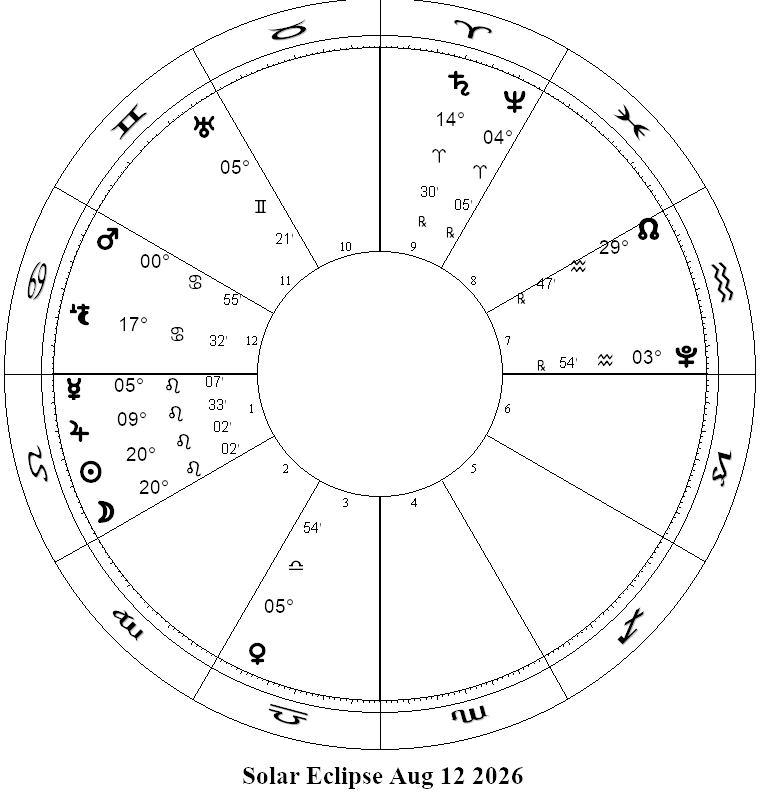
New Moon Solar Eclipse Astrological Summary
Time & Date: Tuesday, Aug. 12, 2026 @ 7:01 a.m. Eastern U.S.
Moon Zodiac Sign: Leo
Moon Speed: Fast
Moon Declination: In bounds
Lunar Mansion: 11 Al Zubrah (Nickname: the Bracelet)
Aspects to the Sun/Moon: None (but Mercury and Jupiter in Leo with the eclipse
Eclipse Lord (Moon's Ruler): Sun in Leo
Aspects to the Eclipse Lord: (see above)
Other considerations: Partial grand sextile with Venus in Libra, Mercury & Jupiter in Leo, Uranus in Gemini, Neptune in Aries and Pluto in Aquarius
A Total Solar Eclipse: Light Extinguished, Then Renewed
This is a total solar eclipse, meaning the Moon passes directly in front of the Sun and fully obscures it. For a brief period, daylight vanishes. The familiar source of light and orientation gives way to darkness at midday.
Astrologically, total solar eclipses operate in the most absolute register. They don’t soften or dilute—they interrupt. Visibility collapses so that something fundamental can reset. Leadership, identity, authority, or direction may be temporarily eclipsed, not to weaken them, but to force redefinition. These eclipses tend to coincide with moments when existing forms can no longer continue
Geography & Visibility: A Northern Emphasis
This eclipse centers largely over the North Atlantic; the path of totality begins in the Arctic before passing over Greenland, Iceland, parts of northern Spain and the northeastern edge of Portugal. Eclipses sometimes pull what they pass over into the spotlight, making headlines about the Arctic, Greenland and Iceland worth watching—particularly around climate research, ice loss, environmental protection or international governance or treaties involving the North Atlantic region.
These issues are unlikely to erupt suddenly. Instead, they point to long-standing conditions and slow-moving realities that continue to shape the global system beneath the surface of daily news.
Saros Cycle 126: Power, Identity, and the Visibility of Authority
This eclipse belongs to solar Saros series 126, a long-running solar eclipse family that began with a partial eclipse in March 1179 CE, during the High Middle Ages—a period marked by the consolidation of monarchy, church authority and hereditary power across Europe. The series reached its peak with a total solar eclipse in August 1778, amid the American and French revolutionary era, when inherited authority and divine right faced open challenge from emerging ideas of sovereignty, citizenship and individual power.
Across its arc, Saros 126 correlates with moments when leadership, legitimacy and identity come under scrutiny—not through quiet erosion, but through visibility and confrontation. By 2026, this series remains in its total phase, emphasizing eclipses that fully obscure existing centers of authority, allowing them to be redefined. The focus here is not collapse, but exposure: who holds power, why they hold it, and whether that authority still commands recognition.
South Node Eclipse: Culmination and Release
This is a South Node solar eclipse, emphasizing endings and release. South Node eclipses bring patterns to the point of exhaustion, revealing what has reached its limit and can no longer be sustained in its current form. They don’t push forward; they call for reckoning.
Here, the eclipse highlights the diminishing return of familiar modes of leadership, identity and authority. What has relied on recognition, performance or inherited legitimacy shows strain. The work of this eclipse is not to announce what comes next, but to clarify what must be relinquished so future direction can eventually take shape. Release here is not dramatic—but it is consequential.
Eclipse Zodiac Sign: Continuing the Aquarius-Leo Cycle
This eclipse occurs in Leo, continuing the Aquarius-Leo eclipse cycle which began in February 2026. Eclipses on this axis highlight the tension between personal authority, visibility, leadership and self-expression (Leo) and collective systems, ideologies and social collectives (Aquarius).
As the lunar nodes continue shifting emphasis toward Aquarius, this eclipse reinforces questions already in motion around who leads, who is seen and how authority is granted or withdrawn. Themes activated earlier in the year around power, recognition and belonging remain active here, pressing unresolved dynamics toward visibility rather than resolution.
Lunar Mansion: Al Zubrah (the Bracelet)
This eclipse falls in the 11th Lunar Mansion, Al Zubrah, which I call the Bracelet. Its influence is associated with respect, prestige and personal magnetism — the quieter forms of visibility that arise through consistency, credibility and self-possession rather than display. This mansion draws attention to reputation and standing, especially the long-term foundations that support recognition over time.
Psychically, Al Zubrah favors dignified self-advocacy and strategic presence. It rewards clarity about one’s value and discourages distractions that undermine authority, such as pettiness, rumor or hesitation to speak when it matters. In the context of a total solar eclipse in Leo, this lunar mansion reinforces a central theme of the moment: visibility must be earned and sustained. What is well-grounded gains traction; what relies on noise or performance alone gradually loses its hold.
Eclipse Lord: Sun in Leo
The Sun rules this Leo eclipse and is eclipsed in its own sign, placing the eclipse lord at the center of the event while simultaneously obscured. Solar eclipses in Leo bring questions of authority, leadership, and identity directly into focus by temporarily removing the very source of visibility and coherence.
When the ruler of the eclipse is both dignified and eclipsed, the effect is paradoxical. The Sun is strong by sign, yet unavailable by condition. Authority doesn’t disappear, but it cannot operate as usual. Power pauses, requiring reassessment of how leadership is exercised, embodied, or recognized before it can reassert itself.
Aspects to the Eclipse
This eclipse does not form any tight, applying aspects to the Sun–Moon conjunction. Instead, its emphasis comes through co-presence. The eclipse occurs in Leo alongside Jupiter and Mercury, placing meaning, belief and communication in the same sign as the eclipse itself.
When an eclipse shares a sign rather than forming sharp aspects, its effects tend to unfold through amplification rather than disruption. Jupiter in Leo enlarges themes of visibility, conviction and confidence. Mercury in Leo brings narrative, interpretation and messaging to the forefront. Together, they shape how the eclipse is understood, discussed, and expressed—even without forcing immediate breaks or confrontations.
This configuration favors story over shock: how events are framed, who speaks who is heard, and how authority is narrated.
Other Considerations: Partial Grand Sextile
In the background of this eclipse, a broader pattern adds context without overriding the eclipse’s central themes. Several planets form a partial grand sextile spanning Venus in Libra, Mercury and Jupiter in Leo, Uranus in Gemini, Neptune in Aries and Pluto in Aquarius — all positions tied into the major astrological stories of the year.
This kind of configuration doesn’t force events on its own, but it creates an underlying web of opportunity — a sense that multiple pathways are available, even as the eclipse itself temporarily obscures the center.
What this pattern contributes is connectivity rather than clarity. Venus emphasizes relationship dynamics, diplomacy and aesthetic values, while Mercury and Jupiter amplify narrative, conviction, and the desire to be heard. Uranus introduces volatility through information and competing ideas; Neptune blurs direction even as it stirs idealism and initiative; Pluto continues its slow reshaping of collective power and ideology.
Together, these influences suggest that while leadership and authority are momentarily eclipsed, conversations, alliances, and emerging possibilities continue to form around the edges. The eclipse removes the spotlight, but the stage remains active — and what develops in the periphery may quietly shape what comes back into view.
Duration of the Eclipse
The Moon is moving more quickly than usual, which makes this a short-duration eclipse. At its maximum, the eclipse reaches just over two minutes of totality, with the longest duration lasting approximately 2 minutes and 18 seconds. Astrologically, the eclipse duration suggests a focused, concentrated activation rather than an ongoing one. The eclipse makes its point clearly, asserting itself decisively without lingering.
Upcoming Eclipse Triggers
Like all eclipses, this one unfolds as later transits activate its degree. Together, these triggers describe a progression: interpretation, amplification and action. The eclipse does not resolve all at once. It develops in stages, each transit pulling its themes further into lived experience.
On Aug. 20, Mercury meets the eclipse degree, marking the moment when the eclipse begins to speak. Information surfaces, conversations sharpen and narratives take shape. This is when the story finds language.
On Oct. 4, Jupiter conjoins the eclipse degree, expanding the eclipse’s reach. What began as a focused interruption gains scale, confidence or ideological weight, pushing eclipse themes into broader public or collective arenas.
On Nov. 3, Mars meets the eclipse degree, activating it through action, confrontation, or decisive movement. Mars transits often coincide with moments when tension must be expressed rather than discussed. Notably, this activation coincides with U.S. election day, underscoring the likelihood that questions of leadership, authority and visibility reach a point of undeniable expression.
Who this Eclipse Affects Most
This eclipse is likely to be felt most strongly by those with planets or angles in the fixed signs, especially Leo, Aquarius, Taurus and Scorpio, roughly between 18°–23°.
Leo placements may experience this most directly, particularly around visibility, leadership, confidence or personal authority. What once felt natural or unquestioned may temporarily lose clarity, prompting reassessment.
Aquarius placements may feel the eclipse through shifts in collective dynamics, public roles, or group affiliations, while Taurus and Scorpio placements are more likely to register its effects through tension around stability, loyalty, resources, or long-standing power structures. As with many solar eclipses, its influence may play out less personally and more mundanely—through leadership changes, public figures or events that spotlight questions of authority and legitimacy.
The Road Ahead
This total solar eclipse in Leo does not introduce a new direction so much as clarify what can no longer hold the center. By temporarily removing visibility, confidence or authority, it exposes where leadership has become performative, inherited or reliant on name recognition rather than substance.
What follows is unlikely to resolve immediately. Instead, the eclipse initiates a period of recalibration, as questions of who leads, who is seen and why authority is granted continue to surface through the months ahead. As later transits activate this eclipse degree, emphasis shifts from interruption to consequence, and from recognition to action.
This eclipse does not demand reinvention on the spot. It asks for honesty about what has reached its limit—and patience as a new relationship to leadership and visibility gradually takes shape.


