What the February 2026 Aquarius Solar Eclipse Signals
Jan 20, 2026
The first eclipse of 2026 doesn’t arrive with a flashy public spectacle. The February 17 annular Solar Eclipse, centered almost entirely over Antarctica, won’t be widely visible — a fact that may make it easy to overlook.
So, astrologically speaking, this eclipse applies pressure rather than drama. It opens a Leo–Aquarius eclipse cycle that will unfold over the next several years, drawing attention to systems under strain, momentum without certainty, and the narrowing space between intention and action. Rather than marking a clean break or dramatic reversal, it exposes limits: of authority, of ideology, and of structures that continue to function even as their weaknesses become harder to ignore.
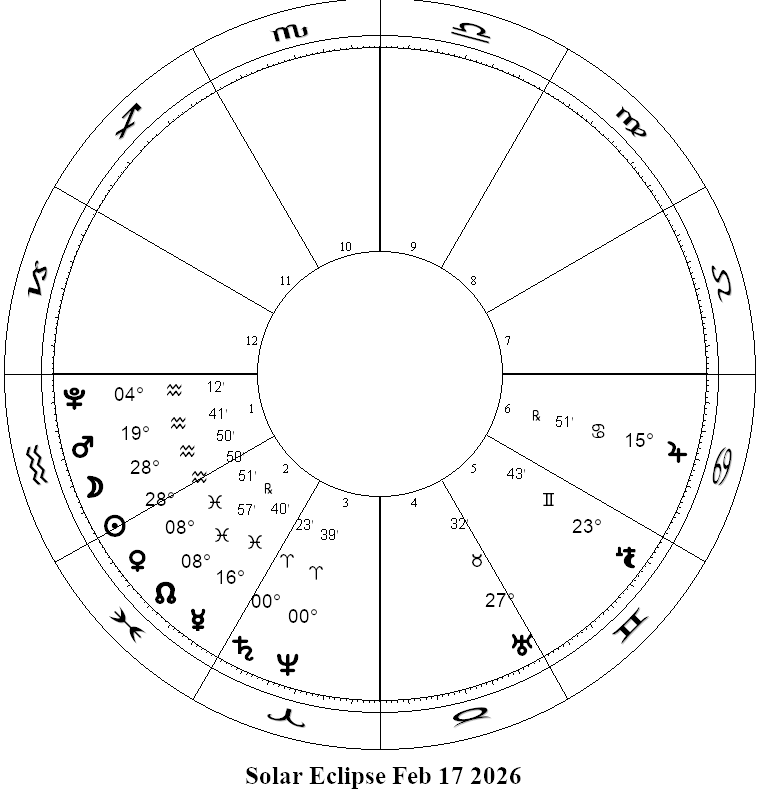
New Moon Solar Eclipse Astrological Summary
Time & Date: Tuesday, February 17, 2026 @ 7:01 a.m. Eastern U.S.
Moon Zodiac Sign: Aquarius
Moon Speed: Normal
Moon Declination: In bounds
Lunar Mansion: 26 Al Fargh al Mukdin (Nickname: the Muse)
Aspects to the Sun/Moon: Sun–Moon square Uranus (separating)
Moon’s Ruler: Saturn in Aries
Aspects to the Moon’s Ruler: Saturn conjunct Neptune in Aries
An Annular Eclipse: Light Diminished, Not Extinguished
This is an annular solar eclipse, meaning the Moon passes directly in front of the Sun but does not fully obscure it. Instead of darkness, a ring of light remains visible—a partial covering rather than a complete interruption.
Astrologically, annular eclipses work in a subtler register than total eclipses. They challenge clarity, leadership, or direction without erasing them entirely. Something essential is weakened, questioned or reshaped, not removed. These eclipses often coincide with transitional periods, when old structures persist even as their limitations become increasingly obvious.
Geography & Visibility: A Southern Emphasis
This eclipse is centered almost entirely over Antarctica, with only a shallow partial eclipse visible from the southern tip of South America and parts of southern Africa. Its strong South Pole emphasis may coincide with renewed attention to Antarctic and Southern Ocean concerns, including climate research, ice loss, environmental protection, and international governance under the Antarctic Treaty.
These issues are unlikely to erupt suddenly during the eclipse. Instead, they point to long-standing conditions and slow-moving realities that continue to shape the global system beneath the surface of daily news over the next six months to a year..
Saros Cycle 121: A Long Arc of Reorganization
This eclipse belongs to Saros series 121, a family that began with a partial solar eclipse in April 944 CE, during the post-Carolingian fragmentation of Europe when centralized authority gave way to regional and ecclesiastical power. The series reached peak intensity with a record-long total eclipse in June 1629, amid the Thirty Years’ War and the religious and political upheavals of early modern Europe.
Across its arc, Saros 121 correlates with periods when established frameworks are strained, reorganized, or redistributed rather than violently overturned. By 2026, the series has entered its late annular phase. Older systems remain in place, but their limits and contradictions are increasingly difficult to ignore.
North Node Eclipses: Re-orientation Before Growth
As a North Node eclipse, this lunation emphasizes movement toward what is still taking shape. While all eclipses involve some form of release, North Node eclipses highlight what must be loosened or outgrown in order to participate in what comes next.
The letting go here is not about returning to the past. It is about adjusting orientation—shedding assumptions, habits or structures that no longer fit the direction unfolding. Growth under a North Node eclipse often feels unfinished at first, asking for engagement before certainty arrives.
Eclipse Zodiac Sign: Opening the Aquarius–Leo Cycle
This eclipse opens a new Aquarius–Leo eclipse cycle that will unfold over the next several years. Eclipses on this axis highlight the tension between personal creativity, visibility and self-expression (Leo) and collective systems, ideologies and social norms (Aquarius).
With the North Node entering Aquarius in late July 2026, this tension intensifies, building on themes already activated by Pluto’s Aquarian journey—especially questions of power, conformity and the shadow side of collective thinking. For some, this eclipse may echo unresolved threads from the previous Aquarius–Leo cycle of 2017–2019, bringing earlier questions of individuality and belonging back into focus.
Lunar Mansion: Al Fargh al Mukdin — The Muse
This eclipse falls in the 26th Lunar Mansion, Al Fargh al Mukdin, which I nicknamed the Muse. It’s associated with inspiration, aesthetic sensitivity, and the desire to refresh what surrounds you. This is a mood-oriented influence, less about decisions and more about attraction — what draws your eye, lifts your spirits, or makes something feel more right again.
Under this lunar mansion, manifestation works through beauty and atmosphere. It’s a good moment for small, restorative changes: updating your appearance, rearranging your space, or spending time with people who remind you what you enjoy. With an annular eclipse dimming the light rather than cutting it off entirely, the Muse favors refinement over reinvention — adjusting what already exists so it feels more aligned and alive.
A Late-Degree Eclipse: The Weight of Inevitability
The Sun and Moon conjoin at 28°50′ Aquarius, a late degree associated with culmination. Late-degree eclipses do not signal crisis for its own sake. They signal inevitability.
Conditions have matured as far as they can. Decisions can no longer be deferred. Structures that persist do so under pressure, and what gives way does so through consequence rather than spectacle.
Eclipse Lord: Saturn at the Threshold
Saturn rules this Aquarius eclipse and is already in early Aries, having re-entered the sign only days earlier. An exact Saturn–Neptune conjunction at 0° Aries follows shortly after the eclipse, placing this lunation at the opening of a major cycle reset.
Saturn is in detriment in Aries, where urgency and drive clash with Saturn’s slower, more cautious approach. As eclipse ruler, Saturn’s condition reflects pressure to act before structures are fully tested or stabilized. With Neptune close by, direction and purpose remain unsettled even as circumstances demand initiative.
Aspects to the Eclipse
The Sun–Moon conjunction at 28°50′ Aquarius forms a tight square to Uranus at 27° Taurus, adding volatility to this eclipse. Uranus squares often coincide with disruption, sudden shifts and breaks from established patterns, especially in fixed signs.
Here, the tension lies between collective systems and ideologies (Aquarius) and material stability, resources, and embodied security (Taurus). Changes that have been resisted may surface abruptly, challenging assumptions about what is reliable or sustainable. This aspect favors reorientation over gradual adjustment, exposing where flexibility has been lacking.
Duration of the Eclipse
At its maximum, this eclipse’s annularity lasts just over two minutes, a relatively brief window compared to longer annular or total eclipses. In astrology, eclipse duration is often used as a rough indicator of how long a degree remains sensitive.
A shorter annularity suggests a concentrated but time-limited activation. The eclipse degree is still sensitized, but its effects are likely only relevant for months rather than years. This eclipse acts like a pressure point—responsive when triggered, then gradually integrating.
Upcoming Eclipse Triggers
Like all eclipses, this one continues to unfold as later transits activate its degree. Two stand out in the weeks that follow.
On March 1, 2026, Mars conjoins the eclipse degree, often marking a moment when tension shifts into action. Urgency increases, and circumstances call for response. Then on April 3, 2026, Uranus squares the eclipse degree, reactivating its themes through disruption, surprise or sudden redirection.
Together, these triggers suggest a story that develops in stages—first through action, then through reassessment.
Who This Eclipse Affects Most
This eclipse is felt most strongly by those with planets or angles in the late degrees of the fixed signs—especially Aquarius, Leo, Taurus and Scorpio, roughly 26°–29°. Aquarius placements may experience heightened visibility or external pressure. Leo placements may feel tension around self-expression, leadership or recognition. Taurus and Scorpio placements are more likely to register disruptions to stability, resources, attachments or entrenched power dynamics.
Even without late-degree fixed placements, eclipses often ripple through collective systems. Many people will notice changes unfolding through institutions, social structures, or group affiliations rather than as isolated personal events.
Mundane Astrology: Pressure on the Horizon
The eclipse closely conjoins the U.S. Sibley Moon at 27°10′ Aquarius, bringing public mood, emotional undercurrents and questions of belonging into sharper focus. What is usually diffuse becomes harder to contain. Nations with charts activated by an eclipse may be unusually sensitive to its triggering effects.
Concurrently, although invisible to residents, this eclipse occurs precisely at dawn in Washington, D.C., rising on the Ascendant of the chart for the nation’s capital. Eclipses on the horizon tend to externalize quickly, shaping visible events, decisions, and public narratives.
In Washington, D.C., the eclipsed New Moon rises just after Pluto and Mars, placing all four bodies at a charged threshold. Power, pressure and forceful initiative come to the foreground. Tensions surface quickly and demand response, especially in matters tied to leadership, governance, and collective direction.
The Road Ahead
This Aquarius solar eclipse marks a consequential turning point, not because it demands immediate change, but because it clarifies where change can no longer be deferred. As an annular eclipse at a late degree, it weakens existing structures without erasing them, exposing the strain they carry and the limits they can no longer hide.
For some, circumstances crystallize and delayed choices move into motion as internal tensions meet external demands. For others, the shift registers more quietly—through growing constraint, reduced flexibility or the recognition that familiar systems no longer respond as they once did. What continues does so under pressure, and what begins to give way does so through consequence rather than outright collapse.
Collectively, the eclipse’s alignment with the U.S. Moon sharpens public mood and shared narratives. Changes in sentiment begin to influence leadership, policy and direction, likely not all at once, but as later transits activate the eclipse degree. This is not a moment of clean resolution. It is the start of a longer reorientation, where decisions are shaped less by ideology than by what proves workable over time.


